
Pre-Employment Assessment Tools for 2027: What Predicts Performance and What They Cost in India
A buyer's evidence check: which assessment formats predict job performance, what published pricing looks like in INR, and where these tools fail.
Which pre-employment assessment formats predict performance, what published INR pricing looks like, and where these tools break, updated for 2027 planning.

TL;DR
Pre-employment assessments still earn a place in 2027 hiring plans, but the evidence behind the formats has shifted. A 2022 re-analysis of selection research found that structured interviews and job knowledge tests predict performance better than cognitive ability tests, which many buyers still treat as the default. Published list prices run from ₹6,900 a month for a core account to ₹35,500 a month for a plus account on annual billing, and at 200 candidates a month the fee alone works out to roughly ₹35 to ₹178 per candidate. Pick the format that measures the actual work first, and price it against your volume. For the screening layer that usually comes before a test, read applicant screening tools for 2026.
What is actually happening
Hiring leaders are buying assessments faster than they are checking them. The category now spans skills tests, recorded video questions, AI-scored interviews, job simulations and personality inventories. The ranked guides that dominate the first page of results mostly compare these products by feature list and category, and few of them show which format predicts performance for which role.
The research base moved in 2022. Sackett, Zhang, Berry and Lievens re-ran the major selection meta-analyses and argued that a standard correction for range restriction had systematically inflated older validity estimates. Their revised operational validities for job performance are structured interviews at .42, job knowledge tests at .40, empirically keyed biodata at .38, work sample tests at .33 and cognitive ability at .31.
That ordering matters because cognitive ability is the test most vendors lead with. In the 1998 meta-analysis by Schmidt and Hunter, cognitive ability sat near .51, and that figure shaped a generation of buying decisions. Cognitive ability still predicts performance, but it is one predictor among several, and it is not the reference point it used to be.
India adds a second pressure. The Digital Personal Data Protection Rules, 2025 were notified on 14 November 2025, and the rules covering breach notification, security safeguards, retention and deletion, and data principal rights come into force 18 months after publication. That points to around May 2027. A candidate's answers, recorded video, identity check and score all sit inside that regime once they are collected from an Indian applicant.
A second cost sits outside the vendor invoice. Every extra step before an interview is a point where a strong candidate can quietly withdraw, especially in competitive roles where people hold two or three offers at once. A long, badly timed test can cost more in lost candidates than the fee it was meant to justify.
Pricing is opaque at the edges. Some vendors publish INR list prices on their own sites, while others route Indian buyers to a demo request before any number appears. Buyers who compare the two without a common unit tend to compare brochures rather than costs.
The numbers
The clearest public pricing we could verify this run comes from TestGorilla's pricing page, checked on 26 November 2026. It lists Assessments Core from ₹6,900 a month per account and Plus from ₹35,500 a month per account, both billed annually and shown in INR. Premium tests cost one credit per candidate and AI interviews and job simulations cost two, but the Core plan uses a shared account-wide credit pool, and the page does not state how many credits each tier includes.
That makes the fee a floor and the credit pool the real cost driver. Chart 1 shows the fee floor per candidate at three monthly volumes, using the annual-billed list prices. Read it as arithmetic (fee divided by candidates), not as a quote.
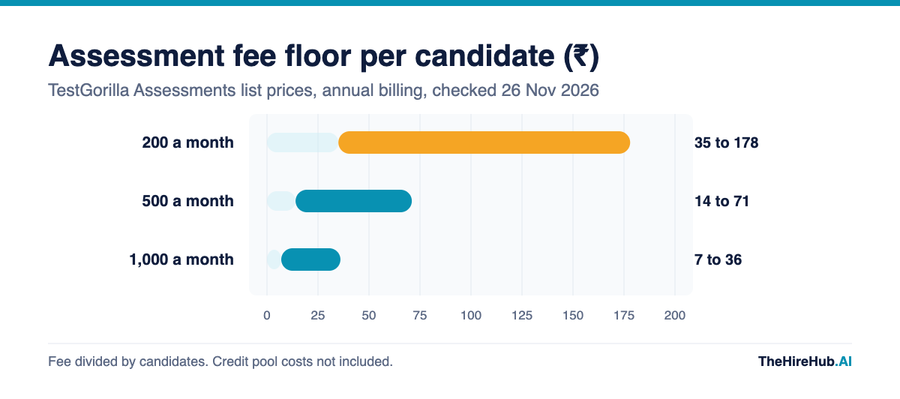
- The left end of each bar is the Core plan and the right end is Plus, so the gap between the two is the price of moving up a tier before any credits are used.
- Divide by completions, not invitations. If only 40 percent of invited candidates finish, the cost per completed assessment is 2.5 times the cost per invitation.
- Use the bar as a ceiling check. If your monthly candidate count sits above the volume you can fund from the credit pool, the fee understates the true spend. The page does not say how many credits a Core account receives, so ask the vendor for that number in writing before you model the budget.
Sources and method
Pricing comes from TestGorilla's public pricing page (annual billing, INR display), checked 26 November 2026. Validity figures are the revised operational validities in Sackett, Zhang, Berry and Lievens (2022), Journal of Applied Psychology, doi 10.1037/apl0000994, as summarised by the authors for SIOP. These figures describe job performance across broad job families, not a specific role, and they say nothing about candidate experience, false negatives or group-level outcomes.
How it actually works, and where it breaks
A pre-employment assessment samples behaviour or knowledge under standard conditions and then scores that sample against a cut-off or a ranking. Its validity depends on how closely the sample resembles the work. A knowledge test for a payroll analyst predicts well, while a general reasoning puzzle predicts less well for the same role unless the job is highly complex.
Four failure modes account for most of the disappointment.
The first is construct mismatch: a personality inventory sold as a job test, or a generic aptitude score used for a role that depends on domain skill. The second is cut-off drift. Thresholds are often set using current employees, who were never selected on the test, and then applied to applicants, which is the range-restriction problem the 2022 authors flagged. The third is integrity: candidates use outside help, and proctoring is a practical limit rather than a solved problem. The fourth is adverse impact, where a tool screens groups unevenly and nobody checks the outcome by stage.
Claims check
- Reach claim. TestGorilla's pricing page says: "Search from 900M+ candidate profiles, then prove who can do the job" (checked 26 November 2026, pricing page). The profile count has no date or method on the page.
The sentence also carries no validity figure for any test.
- Science claim. The same page describes its tests as "science-backed assessments." The page text we checked does not cite a validation study for any named test, so the claim cannot be verified from the vendor's own material.
- Transparency gap. iMocha's India pricing URL redirected to a demo request on the same day, so no list price could be verified for it. That is a commercial choice, but it means the buyer cannot compare costs before a sales call.
Ask every vendor for the criterion-related validity study behind each test you plan to use, the sample size, and the job family it was validated on. A vendor that cannot answer those three questions is selling a format, not evidence.
"An assessment that does not measure the job only adds a score to a decision you have already made."
What this means for your team
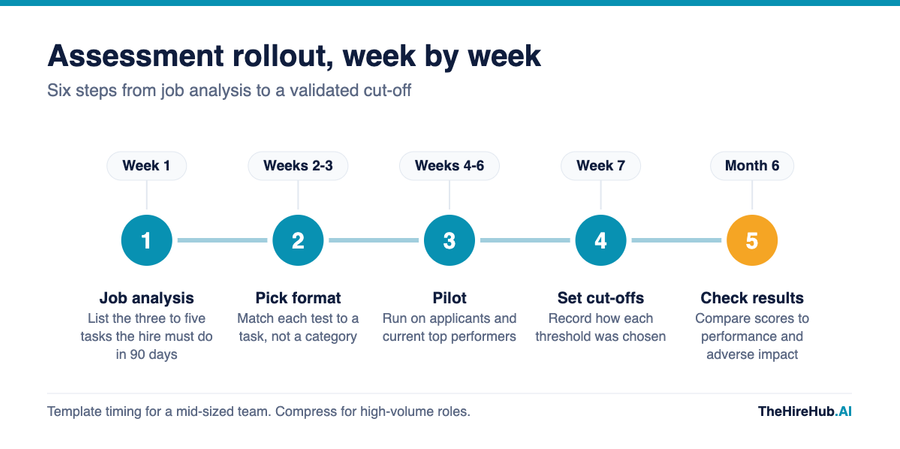
The sequence matters more than the tool. Start with a short job analysis that lists the three to five tasks a new hire must perform in the first ninety days, because that list defines what the assessment must measure. Then pick a format that samples those tasks, pilot it on a small group of current performers, and set the cut-off only after you have seen the score distribution for people who are already doing the job well.
Chart 2 maps that sequence as a timeline. The durations are a template for a mid-sized team, so compress them for high-volume roles and stretch them where you have few data points. Do not skip the pilot. It is the cheapest place to find a test that scores everyone the same way.
Assessment tools vs AI resume screening
Resume screening decides who gets a test, and an assessment decides who gets an interview. The two should run in sequence, not as substitutes. A cheap resume filter is not a validity layer, and an assessment is not a substitute for knowing what the role requires.
The mistake we see most often is letting a resume filter or a generic score stand in for the job analysis. A filter built on keywords tells you who mentions a skill, not who can use it under pressure, and an assessment built on the wrong construct tells you the same thing with a more precise number. Use AI candidate screening tools to narrow the pool, then use an assessment that samples the work. If the next step is a structured interview, AI interview scoring explains what automated scores capture and where they miss.
How to actually do this (and the four traps)
- Testing the wrong trait. Map every test to a task from your job analysis before you buy it. If you cannot name the task, the test is measuring something else, and the score will not predict the work. Skills-based hiring only works when the skill list comes from the job, as this guide on skills-based hiring argues.
- Setting cut-offs on the wrong people. Calibrate thresholds on a pilot group of applicants, or on a documented sample of current performers, and record how you chose the number. A cut-off borrowed from a vendor's demo data is a guess with a logo on it.
- Buying credits you will not use. On the TestGorilla plans, AI interviews and job simulations consume two credits per candidate, and the Core pool is shared across the account. A team that runs a hiring surge can exhaust a pool in a few weeks and face a plan change mid-cycle. Model credit burn by role before you commit to a tier.
- Skipping the privacy design. Before the main DPDP obligations apply around May 2027, write down the purpose, the retention window and the deletion process for every assessment record. The Rules require deletion once the purpose is fulfilled, with advance notice to the individual, and they require logs to be kept for at least a year, so these are design decisions rather than paperwork to finish later. The recruitment data privacy guide covers the practical checklist, and counsel should confirm how the Act applies to your specific flows.
"The cheapest assessment is the one that tells you something you could not have learned from the resume."
The one thing every hiring leader should take from this
Choose assessments by the evidence for the format and the task, not by the category label or the feature count. Structured interviews and job knowledge tests have the strongest revised validity estimates, and work samples follow closely, so start there before you buy a broad cognitive battery.
Price the tool against the candidates you will actually test, and set the budget for the credit pool as well as the plan fee. Write down your privacy design before the 2027 obligations arrive, because retrofitting consent and deletion into a live hiring funnel is harder than building it in. If you are finalising your 2027 plan and want a second opinion on the assessment stack, we look at this stuff all day.
Frequently asked questions
Using the revised estimates from Sackett and colleagues in 2022, structured interviews have the highest operational validity at .42, followed by job knowledge tests at .40 and empirically keyed biodata at .38. Work sample tests (.33) and cognitive ability (.31) follow. The right choice still depends on the job, so run the job analysis first.
Yes, but as one predictor among several rather than the default. The 1998 meta-analysis placed cognitive ability near .51, and the 2022 re-analysis lowered that to .31 after correcting for range restriction. Use it where mental complexity is central to the job, and check the validity study for the specific test you buy.
The fee is the floor, not the total. TestGorilla's Assessments Core plan lists at ₹6,900 a month per account on annual billing, and Plus at ₹35,500 a month. At 200 candidates a month, the fee alone is roughly ₹35 to ₹178 per candidate, before credits for premium tests, AI interviews or job simulations.
No 2027 price list has been published for the tools reviewed here. The figures in this guide are current list prices checked on 26 November 2026, on annual billing. Ask vendors for written 2027 pricing and the credit allocation per tier before you budget for next year.
The Digital Personal Data Protection Rules, 2025 were notified on 14 November 2025. The breach notification, security safeguard, retention and deletion, and data principal rights rules come into force 18 months after publication, which points to around May 2027. Counsel should confirm how the Act applies to your specific hiring flows.
Ask for the criterion-related validity study for each test you plan to use, including the sample size, the job family and the outcome measure. A vendor that offers only general statements about being science-backed, or a profile count with no method, has not shown evidence that a test predicts performance in your roles.
They can. A test can screen out some groups at higher rates than others even when it is job-related, so measure pass rates by stage and by group wherever your legal and data rules allow it. Record the cut-off decision and the reason for it, so you can explain the outcome later.
Usually after a resume screen and before a structured interview, so the interview can focus on what the assessment could not measure. The sequence should follow the job analysis, not a fixed template. For high-volume roles, a short work sample may replace a longer battery.
Not on the current evidence. Structured interviews have the highest revised validity estimate in the 2022 re-analysis, so an assessment works best as a complement that measures knowledge or work samples, with the interview testing judgement and fit against defined criteria.

