What Is Hiring Intelligence? Definition, Tools & Uses for 2027
A plain-English definition, the tools that actually count, and how TA leaders use hiring intelligence to plan 2027 headcount with evidence instead of instinct.
Hiring intelligence explained: a clear definition, the six tool categories that count, the four uses that pay back fastest, and current data to plan 2027 hiring.

TL;DR
Hiring intelligence is the practice of joining your own recruiting data (ATS, HRIS, offers, interviews) with outside market data, then using it to make hiring decisions before they go wrong. The gap it closes is real: in LinkedIn's Future of Recruiting 2025 survey, 89% of talent acquisition professionals said measuring quality of hire will matter more, but only 25% were highly confident they could measure it. Talent intelligence platforms were valued at USD 5.73 billion in 2025, according to Mordor Intelligence, so the tooling exists. For 2027 planning, the question is whether your team can turn its data into decisions, not whether it buys another dashboard. If you have already read our take on building an intelligence stack instead of buying more tools, this is the reference version: definition, tools, uses and numbers.
What is actually happening
What is hiring intelligence?
Hiring intelligence is the use of recruiting data, labour market data and AI to predict and improve hiring outcomes: which roles will be hard to fill, which sources produce people who stay, what an offer needs to look like, and whether a hire worked out. It differs from reporting because it answers "what should we do next", not only "what happened".
Most teams already have the raw material. An ATS records every application, stage move and rejection reason. An HRIS knows who stayed past a year and who got promoted. Offer letters, interview scorecards and agency invoices hold the rest. The problem is that these systems rarely talk to each other, so nobody can answer a simple question like "which source gave us engineers who were still here and rated well after 12 months?"
The pressure to answer that question is rising. SHRM's 2026 Recruiting Benchmarking data brief, drawn from more than 4,600 organisations, found that extra-large organisations saw a 67% increase in median requisitions per recruiter. More work per recruiter means less time for judgement calls, which is exactly where data should carry some of the load.
In India the pressure looks different but lands in the same place. Naukri's JobSpeak index showed white-collar hiring up 2% year on year in September 2026, while AI/ML roles grew 20%. October was sharper: hiring rose 14% year on year and AI/ML jobs climbed 32%, as reported by Staffing Industry Analysts. When demand for a skill grows ten times faster than the market, gut feel about salary bands and time-to-fill goes stale within a quarter.
Why is everyone talking about it for 2027?
Because 2027 budgets are being locked now, and finance teams want hiring plans backed by numbers. A plan that says "we need 40 engineers" gets questioned. A plan that says "we need 40 engineers, our referral channel converts at twice the rate of job boards, and the median senior AI/ML offer in our market moved this year" gets approved.
The numbers
Here is what current, dated data says about the state of hiring intelligence. Every figure comes from a source checked in November 2026.
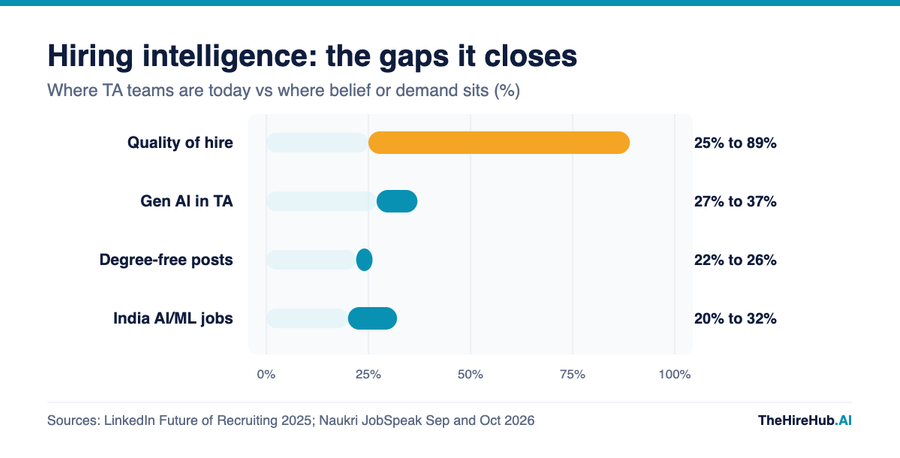
How to read this:
- Each bar shows a gap, not a single score. The left end is what teams do or can do today; the right end is where belief or demand sits. The wider the bar, the bigger the opportunity for hiring intelligence.
- Quality of hire is the widest gap. 89% of TA professionals expect measuring it to matter more, yet only 25% are highly confident they can. That 64-point spread is the core problem hiring intelligence solves.
- India's AI/ML row is a demand signal. Year-on-year growth in AI/ML job listings moved from 20% in September to 32% in October 2026, which means pay and time-to-fill benchmarks for these roles need monthly refreshes, not annual ones.
A few more figures worth knowing for 2027 planning:
- Mordor Intelligence estimates the talent intelligence platform market at USD 6.85 billion in 2026, growing to USD 15.46 billion by 2031, a CAGR of 17.68%.
- LinkedIn found 37% of organisations were integrating or experimenting with generative AI in recruiting, up from 27% a year earlier, and those users saved about 20% of their work week.
- SHRM reports a median non-executive time-to-fill of 39 calendar days in its 2026 brief, down from the prior year.
Sources and method
Figures come from LinkedIn's Future of Recruiting 2025 report (survey of more than 1,000 talent professionals), SHRM's 2026 Recruiting Benchmarking data brief (over 4,600 organisations), Naukri JobSpeak for September 2026 (published 6 October 2026) and October 2026 (as reported by Staffing Industry Analysts on 3 November 2026), and Mordor Intelligence's talent intelligence platform market report. All were checked in November 2026. The chart mixes survey shares and year-on-year growth rates, so compare widths within a row, not across rows. None of these sources publishes a 2027 figure; the 2027 framing here is for planning, not a forecast.
How it actually works, and where it breaks
Hiring intelligence runs on three layers of data, whatever tool you use:
- Internal process data: ATS stage timestamps, source tags, rejection reasons, offer acceptance and interview scores.
- Outcome data: 90-day and 12-month retention, performance ratings and promotion from the HRIS.
- Market data: salary benchmarks, competitor hiring activity, talent pool size by location and skill.
What tools count as hiring intelligence?
Six categories qualify when they produce decisions, not just charts: ATS analytics modules, talent and labour market intelligence platforms, interview intelligence tools that structure and score conversations, skills assessment platforms, sourcing CRMs with source-of-hire attribution, and workforce planning software. If you are weighing whether your current system can do this, our comparison of ATS vs AI recruiting software covers where an ATS stops and an intelligence layer starts.
What are the main uses of hiring intelligence?
The four uses that pay back fastest are: forecasting which requisitions will run late, ranking sources by quality of hire instead of volume, setting offer ranges from live market data, and finding where candidates drop out of the funnel. Each one replaces a recurring argument in the weekly hiring meeting with a number.
It breaks in three predictable places. First, dirty source data: if recruiters tag half of all hires as "LinkedIn" by default, every source-quality model downstream is wrong. Second, no outcome loop: most teams never join HRIS retention back to the ATS, so they optimise for offers accepted rather than hires who succeed. Third, market data treated as truth: salary benchmarks are samples, and a benchmark built on job postings can be months behind what candidates are actually accepting.
Claims check
Vendors in this space lead with big numbers. Here is how three common claim types compare with independent data:
- Data volume claims. Salary.com advertises "800M+ HR-reported data points across 1.4 million+ roles and 225 industries" (salary.com). Volume is not freshness: the page does not say how many points are recent. LinkedIn's survey shows the bottleneck is confidence in measuring outcomes (25%), not access to data. Ask how much of the dataset is from the last 12 months and for your city.
- Speed claims. Qureos promises to "Source Candidates in 5 Seconds or Less" (qureos.com). Sourcing speed and hiring speed are different things: SHRM's median non-executive time-to-fill is still 39 days. Ask what the claim does to time-to-fill, with a baseline.
- Assessment scale claims. iMocha cites "10,000+ real-world evaluations" for skills validation (imocha.io). A large test library is useful, but LinkedIn found 93% of TA professionals call accurate skills assessment crucial to quality of hire. Ask for evidence that scores predict on-the-job performance in your roles.
"A dashboard that never changes a hiring decision is not intelligence, it is decoration with a login screen."
What this means for your team
Rolling out hiring intelligence is a sequence, not a purchase. Here is the order that works for most TA teams of five to fifty recruiters.
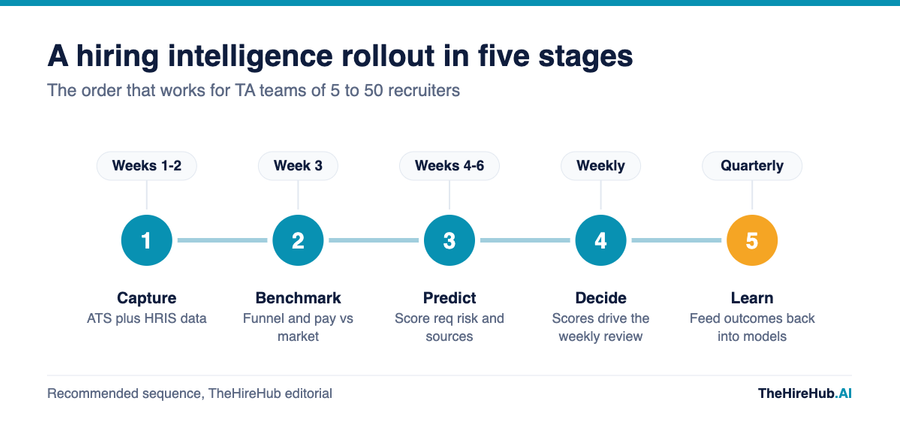
Stage 1, capture. Export ATS stage data and HRIS outcomes for the last 12 to 24 months into one place, even a spreadsheet. Fix source tagging first; it is the field everything else depends on.
Stage 2, benchmark. Compare your funnel against external data. Our recruitment funnel conversion rates benchmarks and cost per hire benchmarks give you a starting line for each stage.
Stage 3, predict. Score open requisitions for risk (role scarcity, salary gap, hiring manager speed) and score sources by 12-month retention. This is where AI earns its place.
Stage 4, decide. Put the scores into the weekly hiring review. If a number never changes a decision, drop it.
Stage 5, learn. Every quarter, feed new outcome data back in, so the models learn which hires actually worked.
Hiring intelligence vs talent intelligence vs recruiting analytics
The three terms overlap, and vendors use them loosely. Recruiting analytics is backward-looking reporting: time-to-fill, cost per hire, funnel counts. Talent intelligence usually means external labour market data plus skills mapping of your existing workforce, often owned by HR or workforce planning. Hiring intelligence sits between them: it applies both internal and market data to live hiring decisions, and it is owned by talent acquisition.
In practice, a team doing hiring intelligence well uses analytics as its input and talent intelligence as its context. Conversation data is one input too; our guide to interview intelligence covers how structured interview scoring feeds the same loop.
How to actually do this (and the four traps)
Start with one question your leadership asks every quarter, such as "why do senior engineering roles take so long?", and build only the data needed to answer it. Then add the next question. Teams that start by buying a platform and connecting everything tend to end up with dashboards nobody opens.
- Measuring volume instead of quality. Applicant counts and InMail response rates are easy to track and rarely predict a good hire. Anchor everything to quality of hire measurement, even if your first version is just 90-day retention plus a manager rating.
- Trusting annual salary data in fast-moving skills. With AI/ML listings in India growing 20% to 32% year on year in autumn 2026, an annual benchmark for these roles is already stale. Refresh offer ranges for hot skills quarterly at minimum.
- Skipping the hiring manager. Intelligence that lives only in TA dashboards changes nothing. Share requisition risk scores with hiring managers before the intake call, not after the role has stalled.
- Letting the model become a black box. If a tool ranks candidates or sources, you need to know why. Ask vendors how scores are built and audit them for bias against groups your hiring policy protects, before you rely on them.
"The teams that hire best in 2027 will not have the most data; they will have the shortest path from a number to a decision."
The one thing every hiring leader should take from this
Hiring intelligence is not a product category you buy in Q1 and tick off; it is the habit of asking "what did our data say?" before every big hiring call. As you finalise your 2027 plan, pick the two decisions that cost you most this year, a late requisition or a bad source, and make sure next year's version of that decision has a number behind it. If you want a second pair of eyes on where your data can do that work, TheHireHub can help, and we look at this stuff all day.
Frequently asked questions
Hiring intelligence means using your recruiting data, your HR outcome data and outside labour market data together to make better hiring decisions. Instead of only reporting what happened, it predicts which roles will be hard to fill, which sources produce people who stay, and what an offer needs to look like to land.
Talent intelligence usually covers external labour market data and skills mapping across the whole workforce, often owned by HR or workforce planning. Hiring intelligence applies internal and market data specifically to live recruiting decisions, such as requisition risk, source quality and offer ranges, and is owned by talent acquisition.
Six categories qualify: ATS analytics modules, talent and labour market intelligence platforms, interview intelligence tools, skills assessment platforms, sourcing CRMs with source-of-hire attribution, and workforce planning software. A tool only counts if its output changes a decision, not just a dashboard.
Start with 12 to 24 months of ATS stage timestamps and source tags, plus HRIS data on 90-day and 12-month retention and performance ratings. Clean source tagging matters more than anything else, because every source-quality model depends on it. Market salary data can be added once the internal data is reliable.
It links each hire back to the source, interview scores and offer terms that produced them, then checks who stayed and performed. LinkedIn's Future of Recruiting 2025 found 89% of TA professionals expect quality of hire measurement to matter more, but only 25% are highly confident they can measure it. Closing that loop is the main job of hiring intelligence.
No. A team of five recruiters can start with a spreadsheet that joins ATS exports with HRIS retention data. Larger teams benefit more from dedicated platforms because volume makes patterns clearer, but the habit of checking data before a hiring decision works at any size.
Pricing ranges from per-user monthly subscriptions for sourcing and interview tools to custom enterprise contracts for talent intelligence platforms, and many vendors only quote on request. Budget for data cleanup and integration time as well as licences, since that is where most rollouts stall.
No major source has published 2027 adoption figures yet, so treat any 2027 number with caution. Current data points one way: LinkedIn found 37% of organisations integrating or experimenting with generative AI in recruiting, up from 27% a year earlier, and Mordor Intelligence forecasts the talent intelligence platform market growing at 17.68% a year to 2031.
Yes, but start with the cheapest layer: cleaning source data and joining ATS and HRIS records. Fund a platform only once you know which two or three decisions you want data to improve, such as late requisitions or low-quality sources. That keeps the 2027 spend tied to outcomes finance can see.
Very. Naukri JobSpeak showed AI/ML job listings in India growing 20% year on year in September 2026 and 32% in October 2026, far faster than overall white-collar hiring. In markets moving that fast, salary bands and time-to-fill estimates go stale quickly, so live data matters more than annual benchmarks.

