
RPO Pricing Models for 2027: What Each One Costs, With India Fee Bands in INR
Management fee, pay per hire and hybrid compared, with vendor-quoted India fee bands and the contract terms that decide the real bill.
RPO pricing models explained for 2027 planning: management fee, per hire and hybrid, India fee bands in INR, a worked example and the minimum-volume trap.

TL;DR
RPO pricing models come in three shapes: a fixed management fee, a pay-per-hire fee, and a hybrid of the two, which is what about half of contracts use. In India, vendor-quoted per-hire fees run from about ₹25,000 for mid-level non-tech roles to ₹4 lakh for niche tech, before 18% GST. The model matters more than the rate, because minimum-volume clauses decide what you pay when hiring slows. If you are setting a 2027 budget, price each model against your own volume forecast before you compare quotes, and read our executive search vs RPO guide if senior roles are in scope.
What is actually happening
The RPO market is coming off a hard stretch. Everest Group's RPO State of the Market 2025 report describes a further market decline in 2024, driven by demand contraction, and notes emerging pricing pressure and a shift toward modular and project-based deals. That is useful context for a buyer. Providers who lost volume are more willing to negotiate structure than they were in 2022.
The large providers are consolidating at the same time. Korn Ferry announced in June 2026 that it would acquire AMS for about $1.1 billion, adding roughly $650 million of run-rate fee revenue, and the deal closed on 1 September 2026. Korn Ferry's own RPO fee revenue grew about 4% in its fiscal year to April 2026. Fewer, larger providers usually means more standardised commercial terms at the top of the market and more flexibility lower down.
What has not changed is how opaque the pricing is. No provider publishes a rate card, and no independent body publishes per-hire RPO benchmarks. The RPO Association's guide to RPO pricing models, updated in December 2024, explains each model in detail and contains no prices at all.
So buyers fill the gap with vendor blogs. Of the five pages we reviewed that rank for this topic in late November 2026, all five were written by a provider or a tool vendor, and only one gave fee bands in rupees. None cited an independent RPO pricing survey newer than 2021.
India adds its own wrinkle. Most Indian teams compare RPO against contingency agencies that charge a percentage of CTC, so RPO gets sold as a discount on agency fees. Buyers in the Gulf face a version of the same comparison, which we cover in our guide to choosing a recruitment agency in Dubai. The discount framing hides the real question, which is who carries the risk when your hiring plan changes.
The numbers
Start with the structure, because it is the only part with independent data. Staffing Industry Analysts' RPO Global Landscape Summary found that a fixed monthly fee plus cost per hire was the most used pricing model, at half of all reported contracts. The same note says the per-hire fee is commonly split, for example 50% when the requisition opens and 50% on hire. That survey is from 2021, and nothing newer is public.
How much does RPO cost per hire in India?
There is no independent benchmark, so the honest answer is a vendor-quoted range. One Indian provider, Supersourcing, publishes indicative 2026 bands drawn from its own engagements: ₹25,000 to ₹70,000 per hire for mid-level non-tech roles, ₹60,000 to ₹2 lakh for mid to senior tech, and ₹1.5 lakh to ₹4 lakh for niche tech. All figures exclude 18% GST. Treat them as an opening position to test, not a market rate.
The same source puts frontline volume roles at ₹3,500 to ₹12,000 per hire and director-level roles at ₹5 lakh to ₹18 lakh. A dedicated recruiter billed monthly is quoted at ₹75,000 to ₹1.3 lakh for non-tech hiring, ₹1.3 lakh to ₹2.4 lakh for tech, and ₹2.5 lakh to ₹4 lakh for niche or leadership sourcing. For hybrid deals in the 100 to 500 hires a year range, the quoted management fee is ₹1 lakh to ₹4 lakh a month, with a reduced fee per hire on top.
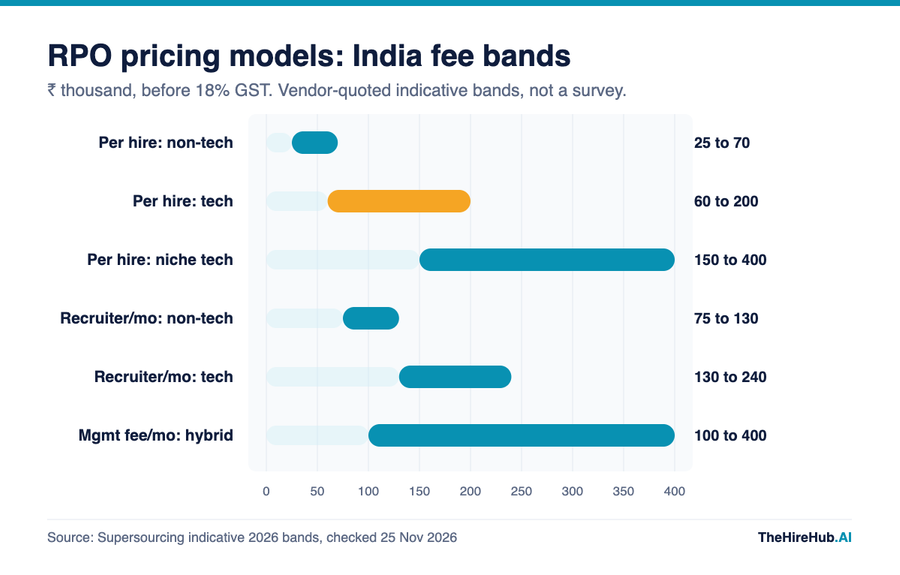
How to read this:
- Per-hire bands and monthly bands are different units. The top three bars are a fee for each hire. The bottom three are a monthly bill, and what they cost per hire depends entirely on how many hires the team closes.
- The widest bar carries the most negotiation room. Mid to senior tech spans more than three times from low to high, so role mix and volume commitment move that quote more than anything else.
- Add 18% GST and pass-through costs. Job board spend, assessments and background checks are often billed separately, so ask for them as a line in the quote.
For a global anchor, SHRM's 2025 benchmarking put the average cost per hire at $5,475 for non-executive roles and $35,879 for executive roles in the United States. Those are averages across all hiring channels, not RPO fees. Our cost per hire benchmarks page has the India equivalents.
Sources and method
The pricing structure data comes from Staffing Industry Analysts (published September 2021) and the RPO Association (December 2024). Market context comes from Everest Group's 2025 state of the market summary and Korn Ferry's June and September 2026 announcements. India fee bands are one provider's published indicative ranges, last modified in October 2026 and checked on 25 November 2026. They are not a survey, they exclude GST, and they do not cover enterprise deals above 500 hires a year, where pricing is negotiated privately.
How it actually works, and where it breaks
Each model moves risk to a different side of the table. A management fee is a fixed monthly or hourly charge for a team, so the provider is paid whether or not you hire. A pay-per-hire model charges an open fee per requisition and a close fee per filled role, so the provider carries the volume risk and prices it in. The RPO Association notes that providers charge a higher overall rate under pay for performance for exactly that reason.
The hybrid tries to split the difference with a base fee plus a smaller fee per hire. An older HRO Today analysis by a TPI adviser put the fixed management fee at 20 to 40 percent of projected monthly fees in a typical deal, with minimum volumes reconciled at the end of each contract year. That reconciliation is called a true-up, and it is where most disputes start.
Three failure modes show up again and again:
- The forecast is wrong. You commit to 120 hires with an 80% minimum and make 70. You still pay for 96.
- The fee triggers on the wrong event. A fee due on offer acceptance, not on joining, charges you for every candidate who drops out during a 60 or 90 day notice period.
- Scope creeps outside the fee. Employer branding, sourcing tools and reference checks get billed as extras that nobody budgeted.
Claims check
Vendor pages on RPO pricing lean on three kinds of number. Here is how each holds up.
- Headline savings. 1840 & Company states that "Cost savings of up to 70% have been reported in global models". No source or baseline is published on the page. Independent data does not offer a savings benchmark at all, so ask what the starting cost was and who measured it.
- Agency-gap multiples. Some providers say an agency hire costs three to four times an RPO hire, based on their own engagements. The comparison holds only when RPO volume is steady. With a missed minimum, the gap narrows quickly, as the worked example below shows.
- Success rates. Joining rates and placement success rates above 95% appear without a denominator, a time period or a definition. Ask for the count of offers, joiners and 90-day leavers for one named year.
"A low per-hire rate with a high minimum is a more expensive contract than a higher rate you can walk away from."
What this means for your team
Run the numbers on your own plan before you take a call with any provider. Here is a worked example, using the vendor-quoted bands above and our own illustrative assumptions.
Assume 120 tech hires in 2027 at an average CTC of ₹15 lakh. A contingency agency at 8.33% to 12.5% of CTC would cost ₹1.5 crore to ₹2.25 crore. Per-hire RPO at ₹60,000 to ₹2 lakh comes to ₹72 lakh to ₹2.4 crore. Two dedicated recruiters at ₹1.3 lakh to ₹2.4 lakh a month, each closing five hires a month, cost ₹31 lakh to ₹58 lakh for the year, or roughly ₹26,000 to ₹48,000 per hire.
Now stress it. Say you sign per-hire RPO at ₹1 lakh with an 80% minimum on 120 hires, and a slowdown cuts you to 70 hires. You pay for 96 hires, which is ₹96 lakh. Your real cost is about ₹1.37 lakh per hire, 37% above the rate you negotiated.
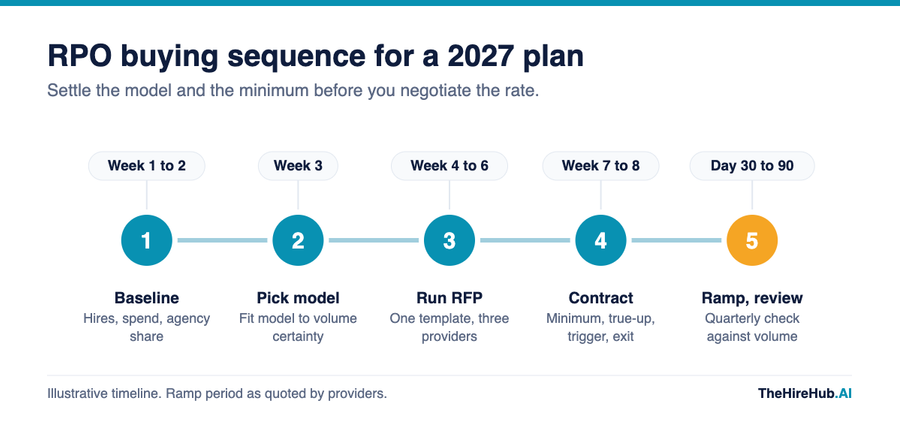
The sequence that avoids this is short:
- Baseline. Count last year's hires by role band, total external spend and agency share.
- Pick the model. Match it to how certain your volume is, not to the lowest quoted rate.
- Run the RFP. Send three providers the same template so the quotes are comparable line by line.
- Contract. Negotiate the minimum, the true-up, the fee trigger and the exit clause before the rate.
- Ramp and review. Providers quote 30 to 45 days before a dedicated team is productive, so plan for it, then review volumes every quarter.
RPO vs the alternative
The nearest alternative is not another RPO provider. It is a contingency agency on one side and software on the other. Agencies charge only on success and need no commitment, which suits fewer than about 25 hard-to-fill roles a year. The trade-off is a fee that rises with every salary increase, a pattern we break down in AI recruiting vs agency.
Software sits at the other end. It removes sourcing and screening hours but leaves your own recruiters to close, so it works when you already have a team that is short on capacity. Our AI recruiting software cost breakdown covers what that layer runs to. RPO fits the middle: steady volume above roughly 100 hires a year, a small or absent in-house team, and roles repeatable enough to run as a process.
Many teams end up with a mix, and that is fine. The mistake is buying RPO to solve a problem that is really about hiring manager speed or an unclear role brief. No pricing model fixes that.
How to actually do this (and the four traps)
Ask every provider to quote the same three scenarios: your plan, your plan minus 30%, and your plan plus 30%. The spread between those three numbers tells you more than the headline rate. Then check the quote against the line items in your recruitment budget planning sheet, so RPO replaces spend instead of adding to it.
- Comparing rates across different models. A ₹60,000 per-hire quote and a ₹2 lakh monthly recruiter are not comparable until you convert both to total annual cost at your expected volume.
- Signing a minimum you cannot hit. Push the committed minimum down to a level you would reach in a bad year, and accept a slightly higher rate in exchange.
- Paying on offer instead of joining. In a market with long notice periods, tie the close fee to the joining date and add a replacement window for early leavers.
- Counting recruiter redeployment as savings. Many business cases assume in-house recruiters are moved or not replaced. If they stay on payroll, the saving does not exist.
"The provider who asks about your worst-case hiring year before quoting is usually the one worth signing with."
The one thing every hiring leader should take from this
If you are finalising a 2027 plan, treat RPO pricing as a risk decision before a price decision. The fee bands in this guide are vendor quotes, checked in November 2026, and your own quote will move with volume, role mix and how much uncertainty you ask the provider to carry. Choose the model that matches how confident you are in your headcount number, negotiate the minimum and the fee trigger first, and model the downside case in writing. If you want a second pair of eyes on a quote or a contract structure, we look at this stuff all day.
Frequently asked questions
There are three. A management fee model charges a fixed monthly or hourly amount for a team. A pay-per-hire model charges an open fee per requisition and a close fee per filled role. A hybrid combines a smaller base fee with a fee per hire, and Staffing Industry Analysts found it in half of reported contracts in its 2021 landscape summary.
No independent benchmark exists. One Indian provider's published indicative 2026 bands, checked in November 2026, run from ₹25,000 to ₹70,000 per hire for mid-level non-tech roles, ₹60,000 to ₹2 lakh for mid to senior tech and ₹1.5 lakh to ₹4 lakh for niche tech, all before 18% GST. Use them to test a quote, not as a market rate.
Nobody has published a 2027 price forecast we could verify, so plan from late 2026 quotes. Because many fees are benchmarked against salary bands, expect quotes to track your 2027 offer levels. Ask providers to hold the rate card for the contract term and to price your plan at 30% lower and 30% higher volume.
The direction of travel from current data is toward modular and project-based deals. Everest Group's 2025 market summary reports pricing pressure and shifts in pricing models after another year of market decline, and the largest providers are consolidating. For buyers, that points to more room to negotiate minimums and exit terms than in earlier years.
A true-up reconciles what you paid against a committed minimum, usually at the end of each contract year. If you hired fewer people than the minimum, you pay the difference. If you hired more, some contracts apply a lower rate to the extra hires. Always ask for the calculation in a worked example before signing.
It can be when volume is steady. In our illustrative example of 120 tech hires at ₹15 lakh CTC, agency fees at 8.33% to 12.5% come to ₹1.5 crore to ₹2.25 crore, while two dedicated RPO recruiters cost ₹31 lakh to ₹58 lakh. The advantage shrinks quickly if you miss a committed minimum, because you pay for hires you did not make.
For fewer than about 25 hires a year, a pay-per-hire or project-based model usually fits, because you avoid a fixed monthly cost. Once hiring is steady and predictable, a dedicated recruiter billed monthly tends to produce a lower cost per hire. A hybrid suits teams in between, provided the minimum is one you would reach in a slow year.
Usually not. Indian RPO quotes are typically stated before 18% GST, and job board spend, assessments and background checks are often billed as pass-through costs. Ask for a quote that lists every pass-through as its own line with a cap, so the total is comparable across providers.
It is a fixed monthly or hourly charge that pays for the provider's team regardless of how many hires close. In hybrid deals it sits alongside a per-hire fee. An older HRO Today analysis put it at 20 to 40 percent of projected monthly fees, and one Indian provider quotes ₹1 lakh to ₹4 lakh a month for 100 to 500 hires a year.

