Recruiter AI Skills in 2026: What to Learn When Only 8% of Teams Are Ready
The bottleneck in hiring automation moved from the software to the judgement needed to run it.
Only 8% of HR leaders say their managers can use AI well, and 88% report no business value from it. What recruiters actually need to learn, and in what order.

TL;DR
Recruiter AI skills are now the binding constraint on hiring automation, not the software. Gartner research found only 8% of HR leaders believe their managers have the skills to use AI effectively, and a separate Gartner survey of 114 HR leaders found 88% say their organisations have not realised significant business value from AI tools. The tools are deployed and the capability is not, which is why the value keeps failing to show up. If you are still asking the prior question, start with our take on will AI replace recruiters, then come back here for what to actually learn.
What is actually happening
The recruiting stack got smarter faster than the people running it did. Buying decisions moved at software speed while training moved at budget-cycle speed. The result is a large installed base of capable tools operated by people who were never taught what good operation looks like. Nobody planned this, and almost everybody has it.
Gartner named the shift directly in its 2026 talent acquisition trends: one of the four forces reshaping the function is that recruiter skills shift for more complex work. The reasoning is not sentimental. As automation absorbs the low-complexity end of the job, what remains for a human is the hard end, and the hard end needs different skills than the ones that got most recruiters promoted.
Gartner's description of the new recruiter role is specific. Recruiters must advise on talent strategy and role design for hard-to-find skills, build long-term relationships with prospects who are difficult to reach, and assess whether a candidate fits the organisation's future needs rather than only the role as written today. None of those three are sourcing skills. All three are judgement skills.
There is a second, less comfortable finding underneath the first. In the same Gartner survey that produced the 88% figure, only 7% of organisations give employees any guidance on how to use the time that AI frees up. So even where automation works exactly as sold, the recovered hours have no assigned destination. The time gets absorbed into more of the same work rather than reinvested into the complex work that now has nobody doing it.
That is the honest state of play. It is not that AI underdelivers in recruiting. It is that most teams have not decided what the humans are for once it delivers.
The numbers
Deployment in recruiting is both narrower and shallower than the discourse suggests. SHRM's State of AI in HR 2026 found roughly 27% of organisations use AI to support recruitment at all, and within that, usage clusters at the drafting and parsing end rather than the judgement end.
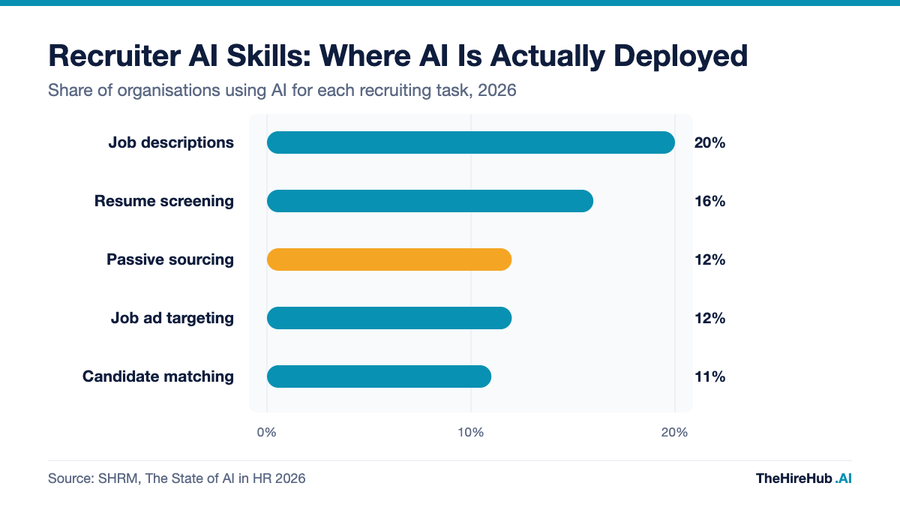
Three things to read off this:
- The heaviest adoption is in the tasks with the lowest judgement content. Drafting a job description is the most automated activity in recruiting, and it is also the one where a bad output is most visible and cheapest to fix.
- Passive sourcing and candidate matching sit at the bottom, around 11% to 12%, despite being the two use cases vendors market hardest. These are the tasks where a wrong answer is invisible, which is exactly why adoption is cautious and why skill matters most.
- The gap between the top and bottom bar is the skills gap in disguise. Teams automate what they can evaluate, and they can only evaluate what they understand.
Two forward numbers set the deadline. Gartner predicts that by 2027, 75% of hiring processes will include certifications or tests for workplace AI proficiency, meaning your candidates will be assessed on this before your recruiters are. And by 2030, Gartner expects half of enterprises to face irreversible skill shortages in critical roles, which is the environment in which the complex hiring your recruiters are not yet trained for becomes the only hiring that matters.
How it actually works, and where it breaks
The mechanism is straightforward. An AI layer sits across sourcing, screening and scheduling, proposes an action, and a recruiter accepts or overrides it. Value comes from two places: the time saved on the proposal, and the quality added by the override. Most teams measure the first and never instrument the second.
That is the first failure mode, and it is the expensive one. When only throughput is measured, the rational recruiter accepts everything, because overriding costs time and earns no credit. Acceptance rates drift toward 100%, the human layer becomes ceremonial, and the system quietly inherits every weakness of the model underneath it. This is how AI screening false negatives accumulate without anyone noticing: the qualified people who get filtered out never appear in any report.
The second failure mode is calibration. Recruiters are rarely shown whether their overrides were right, so they never learn. A recruiter who overrode fifty screening decisions last quarter has no idea how many of those candidates went on to perform, because nobody joined the data back up. Without that loop, override behaviour is just personality, and personality is not a skill.
The third is trust asymmetry, and it points outward at candidates. Only 26% of applicants told Gartner they trust AI to fairly evaluate them, and detection tooling has a measurable bias problem: Stanford researchers found seven AI detectors classified 61% of TOEFL essays by non-native English writers as AI-generated. A recruiter who cannot explain what the tool does, or who defers to a flag they do not understand, converts a model error into a rejected person.
"The skill is not running the tool. It is knowing, on a specific candidate, when the tool is confidently wrong."
What this means for your team
Treat this as a capability rollout, not a training day. The sequence below is deliberately slow at the start, because the two most common failures are both front-loaded: nobody knows what is already automated, and nobody owns the automated decisions.
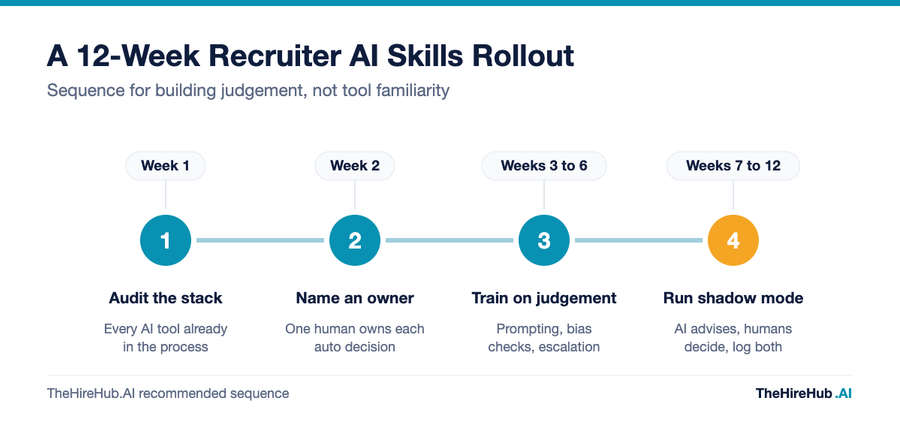
The unglamorous first two weeks do most of the work. An audit almost always surfaces tools that a previous recruiter switched on and nobody has reviewed since, and naming an owner for each automated decision is what makes the later measurement possible at all. Shadow mode is the part teams want to skip and should not. Running the AI in parallel while humans still decide gives you the only clean comparison you will ever get, and it is the phase where recruiters actually build calibration rather than being told about it.
One structural note: keep a named human accountable for every rejection decision, not just a human in the room. That distinction is the whole substance of human in the loop hiring, and regulators in several jurisdictions now treat it as the difference between compliant and not.
Recruiter AI skills vs hiring an AI specialist
The tempting alternative is to hire one person who understands the tooling and let the rest of the team carry on. It works for procurement and fails for judgement. A specialist can configure a matching engine, but they cannot sit inside every screening decision, and screening decisions are where the value and the liability both live.
The distinction matters because the two approaches solve different problems. A specialist fixes the stack. Distributed recruiter AI skills fix the decisions. If your recruiters cannot articulate why a model surfaced a particular candidate, no amount of central expertise will stop them from either rubber-stamping or ignoring it. The right split is usually one owner for the stack and calibration training for everyone who touches a candidate, which also happens to be what makes quality of hire measurement possible rather than theoretical.
How to actually do this (and the four traps)
- Train on judgement, not on buttons. Tool training ages out with the next release. Teach recruiters to state what a model optimised for, what it could not see, and what evidence would change their mind. Those three questions transfer across every vendor you will ever use.
- Instrument the override, not just the throughput. Log every acceptance and rejection of an AI recommendation, then join it to outcomes at 90 days. If you cannot tell a good override from a bad one, you are not running a human in the loop, you are running a rubber stamp with a salary attached.
- Assign the recovered time before you recover it. Only 7% of organisations do this, and it is why efficiency gains evaporate. Decide in advance that the hours saved on scheduling go to prospect relationships or hiring manager calibration, and put it in the recruiter's objectives.
- Make candidate-facing explanation a required skill. Every recruiter should be able to say, in one plain sentence, where AI sits in your process and how a candidate can opt out. This is not a compliance chore. It is the cheapest fix available for the trust problem described in our piece on candidate experience in AI hiring, and it is also what stops a detection flag from becoming a false accusation, as covered in AI interview cheating detection.
"A team that cannot explain its automated decisions to a candidate cannot defend them to a regulator either."
The one thing every hiring leader should take from this
The bottleneck moved. It used to be tooling and now it is the judgement to operate the tooling, and that is a training problem with a deadline attached rather than a procurement problem. The teams that will look good in 2027 are the ones that spent 2026 teaching recruiters when to overrule the machine and then measured whether they were right. Everyone else will have excellent software, unchanged outcomes, and a growing pile of rejections nobody can explain.
Sources
- Gartner, Only 8% of HR Leaders Believe Their Managers Have the Skills to Effectively Use AI
- Gartner, 88% of HR Leaders Say Their Organizations Have Not Realized Significant Business Value from AI Tools (survey of 114 HR leaders)
- Gartner, AI Revolution and Cost Pressures Drive the Top Four Trends for Talent Acquisition in 2026
- Gartner, Just 26% of Job Applicants Trust AI Will Fairly Evaluate Them
- SHRM, The State of AI in HR 2026
- Stanford HAI, AI Detectors Are Biased Against Non-Native English Writers
Hiring shouldn't have to feel harder just because the talent market is more competitive.
At TheHireHub.ai, we help hiring teams simplify the process from finding the right candidates to assessing and ranking them, so your team can spend less time managing the hiring process and more time making the right decisions.
If you're looking to make hiring easier, faster, and better, we'd be happy to help.
Frequently Asked Questions
Recruiter AI skills are the judgement skills needed to operate an automated hiring process: knowing what a model optimised for, what it could not see, when to override its recommendation, and how to explain the process to a candidate. They are not the same as knowing how to click through a specific vendor's interface, which ages out with the next release.
The evidence points to role change rather than replacement. Gartner's 2026 talent acquisition research frames the shift as recruiter skills moving toward more complex work: advising on talent strategy and role design, building relationships with hard-to-reach prospects, and assessing candidates against future needs rather than only the current role.
Only 8%. That figure comes from Gartner research published in October 2025, and it is the clearest available measure of the gap between AI deployment and AI capability inside HR functions.
A Gartner survey of 114 HR leaders found 88% said their organisations had not realised significant business value from AI tools. A large part of the explanation is that only 7% of organisations give employees any guidance on how to use the time AI frees up, so recovered hours are absorbed rather than reinvested.
Start with override judgement: how to read what a model recommended, articulate why it might be wrong for a specific candidate, and decide accordingly. Prompting technique matters less than knowing when a confident recommendation should be rejected.
Plan for roughly 12 weeks. One week to audit which AI tools are already live in the process, one week to assign a named owner to every automated decision, four weeks of judgement training, and six weeks running the system in shadow mode where AI advises and humans still decide.
Shadow mode means the AI produces a recommendation while humans continue to make the actual decision, and both are logged. It is the only clean way to compare machine and human judgement on the same candidates, and it is the phase where recruiters build genuine calibration.
Log every acceptance and rejection of an AI recommendation and join those decisions to outcomes at 90 days. If you cannot distinguish a good override from a bad one, you have a rubber stamp rather than a human in the loop.
Gartner predicts that by 2027, 75% of hiring processes will include certifications or tests for workplace AI proficiency. In many organisations candidates will be formally assessed on AI capability before the recruiters evaluating them are.
A specialist can configure the stack but cannot sit inside every screening decision, which is where both the value and the liability concentrate. The workable split is one owner for the tooling plus calibration training for everyone who touches a candidate.


