
AI-Generated Job Applications in 2026: What the Volume Surge Actually Costs Your Hiring Team
Applications per recruiter rose 412 percent in three years while recruiting teams halved, and the fix is not a bigger filter.
The average open role now draws 244 applications and the average recruiter absorbs 746 a year. What AI-generated job applications actually cost you, and how to respond.

TL;DR
The average open role now draws 244 applications and the average recruiter absorbs 746 applications a year, up 412 percent since 2022. Most of that growth is AI-generated job applications: candidates using assistants and auto-apply tools to submit at close to zero cost. Over the same period the typical recruiting team shrank 56 percent, from 10.43 recruiters to 4.62. The answer is not a stronger filter, it is a narrower front door plus a screening process you can audit, which is a different project from buying AI resume screening.
What is actually happening
Between 2022 and 2025, Greenhouse tracked more than 640 million applications across over 6,000 companies. Applications per job rose from 116 to 244. Applications per recruiter rose from 146 to 746. Recruiters per organisation fell from 10.43 to 4.62.
Those four numbers describe a single event. The cost of submitting an application fell to roughly zero while the cost of reading one did not move at all. LinkedIn now processes about 11,000 application submissions per minute, a 45 percent jump year on year, and attributes much of that rise to generative AI.
The result is not simply more applications. It is more applications that look alike. 77 percent of hiring teams say they now regularly encounter AI-generated or AI-assisted applications, up from 53 percent in early 2024, according to the Willo Hiring Trends Report 2026. When every cover letter has been polished by the same handful of models, the cover letter stops carrying signal.
Recruiters have not collapsed under this. Monthly hires per recruiter rose 122 percent, from 2.2 to 4.9, and the share of jobs closed with a hire improved 8 percent. But time to fill went from 43.6 days to 59.7 days, a 37 percent increase. Teams are closing more roles and taking materially longer to do it.
There is a second order effect that shows up in the interview stage rather than the inbox. When applications are cheap, the correlation between applying and actually wanting the job weakens. Recruiters report scheduling loops with candidates who cannot describe the role they applied to, which is expensive in a way that never appears in an application volume dashboard.
Greenhouse chief executive Daniel Chait calls the pattern an AI doom loop: candidates use AI to apply more, employers use AI to filter more, rejected candidates respond by applying even more. Everyone optimises locally and the whole system degrades. That framing matters because it tells you where the fix cannot come from.
In India the volume story arrives alongside genuine hiring growth rather than a freeze. Naukri's JobSpeak index recorded 12 percent year on year white collar hiring growth in February 2026 and 6 percent in June 2026, with AI and machine learning roles up 25 percent. Rising requisition counts and a collapsing cost of applying push in the same direction.
The numbers
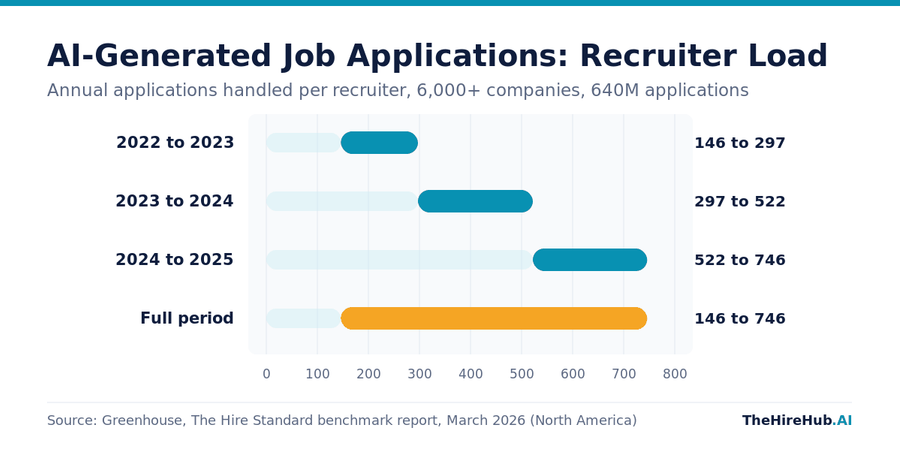
Read this as a load curve rather than a growth chart. Each bar is the additional annual application volume one recruiter absorbed in that period.
- The recruiter line grew far faster than the per role line (412 percent versus 111 percent) because team size fell 56 percent at the same time. Volume is only half the story: capacity is the other half.
- The steepest single jump was 2023 to 2024, when annual load per recruiter rose by 225 applications. It has not flattened since, adding another 224 in the year to 2025.
- These are medians across 6,000 companies. One high visibility remote role can draw over 1,000 applications on its own, so your worst requisition will look nothing like the median.
How it actually works, and where it breaks
The mechanism is mundane. A candidate pays roughly 20 dollars for a tool that reads a job description, rewrites their resume against it, and submits, repeatedly, without them present. The tool does not need to be good. It only needs to be cheaper than reading the job description carefully, which it is by several orders of magnitude.
What makes this hard is that the tool's output is not obviously bad. A model given a job description and a real work history will produce a plausible, well structured, on-keyword application. It is not fabricated in most cases, it is simply optimised, and optimisation against your stated criteria is exactly what your screen was built to reward.
That produces three failure modes, and they compound.
The signal you were screening on has disappeared. Keyword overlap and writing quality used to separate the candidate who cared from the one who did not. Both are now free. Any shortlist that still implicitly prices effort is measuring an input that stopped existing.
Your filter inherits the flood. Automated screening configured against the old distribution will happily pass polished machine text and reject rougher human text from someone who can actually do the job. The filter is not broken, it is answering the question you asked it in a world that changed underneath the question.
The mistakes are invisible. You see every bad hire. You never see the qualified person your screen dropped in round zero, which is why AI screening false negatives go uncorrected for years. No dashboard reports them because there is nothing to report.
"The application is no longer evidence of effort, so any process that still prices effort into the shortlist is measuring something that stopped existing."
What this means for your team
The sequence below is what a functioning response looks like. It is deliberately front-loaded: the cheapest and highest leverage work happens before any tooling decision.
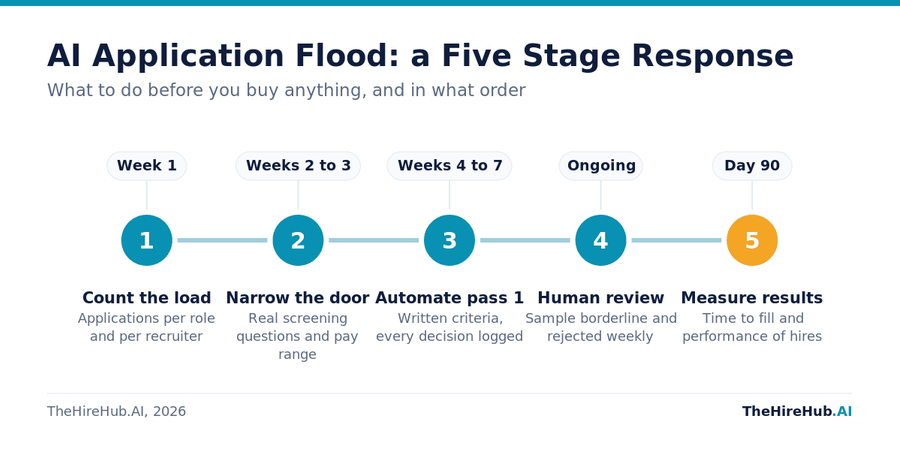
Stage one is counting. Pull applications per open role and per recruiter for the last four quarters and find your own version of the 244 figure. Most teams have never looked, and the distribution is usually far more skewed than the average suggests.
Stage two is the front door, and it is where most of the win sits. Two or three genuine screening questions that require reading the role, an honest compensation range, and a specific rather than generic job description will remove a large share of untargeted volume before it enters your funnel. This costs nothing and no vendor sells it.
Stage three is the first pass. If you automate it, define the criteria in writing before you configure anything, and log every decision so it can be reviewed later. Stage four adds the human checkpoint on the borderline and rejected pile, which is also where you protect candidate experience in AI hiring from becoming a silent rejection machine.
Stage five is measurement, at 90 days, on time to fill and on whether the people you hired are working out. Anything that moves volume metrics but not those two has not helped you.
AI-generated job applications vs the old resume pile
The old resume pile was a capacity problem. There were more applications than hours, the applications were noisy but independent, and sampling harder or hiring another coordinator genuinely helped. Throwing headcount or a better applicant tracking system at it worked because the underlying signal was intact.
This is a signal problem wearing a capacity problem's clothes. The applications are correlated now, because they were produced by the same small set of models against the same job description, so sampling more of them tells you less per unit read.
That distinction is why the ATS vs AI recruiting software question keeps getting answered badly: an ATS organises a pile, it does not restore signal to it. The techniques that do work at genuine scale, covered in our guide to screening 1,000 candidates with AI, all involve introducing new evidence rather than re-reading the old evidence faster. New evidence means a short structured exercise, a scheduled conversation, a verifiable work sample: something the candidate has to be present for.
The practical test is simple. Ask what your process would do if application volume doubled again next year. If the answer is that you would screen harder, you have a capacity plan for a signal problem, and it will fail in the same way a second time.
How to actually do this (and the four traps)
- Do not answer volume with a bigger filter. Adding a stricter automated screen to a correlated application pool raises your false negative rate faster than it raises precision. Narrow the input first, then filter what remains. A role that receives 60 well targeted applications is a better hiring position than one that receives 600 and rejects 95 percent of them automatically, even though the second looks more impressive in a report.
- Do not treat AI assistance as disqualifying. A candidate using a model to write a cover letter is doing what the tooling and the market reward. Screening for AI use, rather than for capability, will cost you strong candidates and cannot be defended if a rejected applicant asks how the decision was made.
- Do not automate the rejection decision without a reviewer. Keep a named person on borderline and rejected cases, sampled weekly. This is the practical core of human in the loop hiring, and in several jurisdictions it is now the difference between a defensible process and an undocumented one.
- Do not measure success as applications processed. Processing more is trivially easy and tells you nothing. Measure time to fill, offer acceptance, and 90 day performance of hires. If a change improves throughput while time to fill keeps climbing, it did not work. The Greenhouse data is a useful warning here: teams genuinely improved throughput and close rates over this period, and time to fill still rose 37 percent.
"Every team that fixed this narrowed what came in before it touched what went out, and the ones that did it the other way round are still drowning."
The one thing every hiring leader should take from this
The flood is not going to recede, because nothing in the incentive structure points that way. Applying will keep getting cheaper and your team will not get bigger. The teams handling this well in 2026 are not the ones with the most aggressive screening: they are the ones who narrowed what enters the funnel, wrote down how decisions get made, and kept a human on the rejections.
That is a process decision, not a procurement one.
Hiring shouldn't have to feel harder just because the talent market is more competitive.
At TheHireHub.ai, we help hiring teams simplify the process from finding the right candidates to assessing and ranking them, so your team can spend less time managing the hiring process and more time making the right decisions.
If you're looking to make hiring easier, faster, and better, we'd be happy to help.
Frequently Asked Questions
Greenhouse data covering over 640 million applications across more than 6,000 companies puts the figure at 244 applications per open role in 2025, up from 116 in 2022. That is a 111 percent increase in three years. Medians hide a lot of skew: a high visibility remote role can draw over 1,000 applications on its own.
Both, but the volume is the smaller half. The harder issue is that applications produced by the same handful of models against the same job description are correlated, so reading more of them yields less new information per application. Your screening signal degrades even if your capacity holds.
No one has a reliable platform-wide count, because AI assistance sits on a spectrum from light editing to fully automated submission. What is measured is exposure: 77 percent of hiring teams say they regularly encounter AI-generated or AI-assisted applications, up from 53 percent in early 2024, per the Willo Hiring Trends Report 2026.
Screening for AI use rather than for capability is a poor trade. Candidates are responding rationally to tools the market rewards, detection is unreliable, and a rejection you cannot explain is hard to defend if the candidate asks. Screen for what the person can do instead.
Not at a standard you would want to make hiring decisions on. Detection accuracy falls sharply on short, edited, or partially human text, which describes most applications, and false positives land disproportionately on non-native English writers. Treat detector output as weak evidence at best.
Because triage expanded faster than productivity did. Greenhouse recorded a 122 percent rise in monthly hires per recruiter between 2022 and 2025 while time to fill still rose 37 percent, from 43.6 days to 59.7 days. More output per person did not offset a 412 percent rise in application load against a 56 percent smaller team.
Tighten the front door before touching your filters. Two or three genuine screening questions that require reading the role, a published compensation range, and a specific rather than generic job description will remove a meaningful share of untargeted volume at zero cost and with no vendor involved.
An applicant tracking system organises a pile, it does not restore signal to it. If the applications entering the pile are increasingly similar to each other, better storage and workflow will make the pile easier to move through without making your shortlist any better.
You have to go looking, because false negatives never appear in a dashboard. Sample rejected applications weekly, have a human review a fixed number of borderline cases, and track whether hires sourced outside the automated screen outperform those sourced through it.
Time to fill, offer acceptance rate, and 90 day performance of hires. Applications processed and screening throughput are easy to improve and tell you nothing about hiring quality. If throughput improves while time to fill keeps climbing, the change did not work.


