
Ghost Job Postings in 2027: How to Clean Up Stale Reqs Before You Recruit
Why aged requisitions quietly cost replies, and the cleanup TA leaders can run in a week.
Greenhouse classifies 18 to 22 percent of its job postings as ghost jobs each quarter. A five-step req cleanup, with the numbers and failure modes behind it.

Greenhouse classifies 18 to 22 percent of the jobs on its platform as ghost jobs in any given quarter, and candidates have noticed. Ghost postings are not mainly a copywriting problem. They are a requisition hygiene problem: roles that outlived their budget, pipeline reqs that read as urgent, and listings nobody owns. The fix is a five-step cleanup you can run in a week and repeat each quarter. If you are finalising 2027 headcount, start with recruitment budget planning, then come back here before you source a single aged role.
What is actually happening
A ghost job is a posting with no real plan to hire soon. Most of them are not fraud. They are requisitions that outlived the plan behind them: a budget that froze, a hiring manager who moved on, or an evergreen pipeline role nobody took down.
Three things keep them alive. The first is ownership: finance can freeze a req in one meeting, but nobody is asked to take the posting down. The second is pipeline hiring, where a team opens a role to build a bench and then recruits against it as if it were urgent. The third is syndication, because the Congressional Research Service notes that third-party job boards can copy postings automatically.
Candidates have learned to read for these signs. Greenhouse found that three in five candidates suspect they have applied to a ghost job. The same research found 61 percent of candidates were ghosted after an interview, up nine points since April 2024, so the trust problem runs in both directions.
What makes this painful is that the cost is hard to see on a standard dashboard. Average time-to-fill can look acceptable because stale roles dilute your pipeline volume rather than your fill rate. The complaint shows up instead as a slump in replies that nobody traces back to one req, so recruiters tend to blame subject lines or the candidate market.
Regulators have started to notice. On June 2, 2026, New York lawmakers passed S8877, which would require employers with 100 or more employees to state whether a role is a current vacancy and when it is expected to be filled. Each noncompliant posting would carry a $2,500 fine. In the reporting we checked, the bill was awaiting delivery to the governor, so treat it as pending rather than law.
For a 2027 plan the practical point is simple. A posting that could not survive a disclosure rule is already costing you replies, whether or not a statute arrives.
The numbers
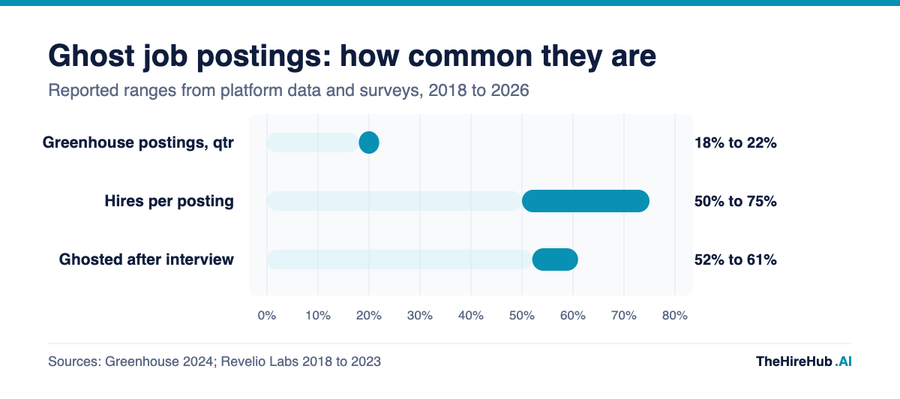
The figures below are not one rate measured one way. Greenhouse counts jobs its own system classifies, Revelio counts hires against postings, and Greenhouse's candidate survey counts people. Read them as a range of how often ghost postings show up. 2027 is the planning frame for this post, not a forecast, and every figure is dated.
How to read this
- Platform share: Greenhouse's 18 to 22 percent is a classification on its own job board in any given quarter. It is not a census of the market, and it does not tell you how many of your own reqs qualify.
- Hires per posting: Revelio Labs matched postings to hires within six months and found the ratio fell from 0.75 in 2018 to below 0.5 in 2023. Its page was updated in November 2026, but the ratio it reports is still the 2023 figure.
- Candidate trust: The ghosting range runs from about 52 percent in April 2024 to 61 percent by late 2024. Your candidates are the ones doing that counting, which is why a stale posting costs more than a single reply.
Sources and method
Greenhouse's 2024 State of Job Hunting report surveyed 2,500 workers across the US, UK and Germany, and its ghost-job share is a classification on its own job board, not an audit of any employer. Revelio Labs matched postings to hires within six months, and its series ends in 2023. The New York details come from HR Dive's June 2026 reporting on S8877. None of these measure your funnel, so use them to set the stakes and then measure your own reqs by age.
How it actually works, and where it breaks
A ghost job starts as a real need that stops being true. A backfill resolves internally, but the posting stays live because the ATS has no field for "still funded" and nobody is paid to check. Over a quarter that gap grows quietly until the careers page carries roles nobody is working.
The first failure is ownership. Requisitions usually carry a recruiter's name and a hiring manager's budget, but the decision to close belongs to nobody in particular. The second is pipeline roles posted as urgent, which candidates spot quickly. The third is syndication: a req you close in your ATS can remain visible on an aggregator after you have closed it.
Consider an illustrative version of this. A platform engineering req opens in March. In June the budget moves to another team, and nobody tells the recruiter. The req stays live, sourcing continues, and by September the outreach is landing on a role that cannot hire. The recruiter did nothing wrong; the system never asked the question.
Claims check
Vendors in this category make big claims about reply rates and speed. Here is one example, read against independent data.
- Reply-rate claim: Pin's ghost jobs study says its sequences "deliver response rates 5x higher than industry averages." The page names no source for the industry baseline, and the independent figures we could verify support the stale-req problem but not that multiplier.
- Stale-req claim: Pin's sample shows roles open 90 days or more earned fewer replies than fresh ones, which matches the direction of the labor data. The page itself calls this correlation, not proof that distrust causes the gap.
"A stale requisition does not just waste sourcing hours; it teaches every candidate who reads it to doubt your next message."
What this means for your team
Treat aged reqs like inventory. Every role open 90 days or longer should pass a funding check before anyone sources against it. If the budget is gone, close it. If the budget is there but the role is a bench, say so in the posting itself.
Assign the owner before you run the audit, not after. The owner should be the person who sees a req's status change first, usually the recruiter, with the hiring manager signing off on the funding answer. Give that person one shared list with three columns: funded, paused, and pipeline. Anything that cannot be placed in one of those columns is closed by default until someone defends it.
Here is a worked example with illustrative numbers, not measured data. A team with 15 reqs older than 90 days sends 2,000 outreach messages to that group in a quarter. At the 8.4 percent reply rate in Pin's sample, that yields about 168 replies, against roughly 226 at the 11.3 percent rate for fresh roles, so the aged backlog costs around 58 replies a quarter.
For India hiring the mechanics are the same across Naukri, LinkedIn and company career pages. A role a hiring manager paused in one city can still pull applications in another. We have not found a verified India-specific ghost-job share, so this post does not quote one.
The sequence below is the cleanup we would run in a week, then repeat every quarter so the backlog cannot rebuild quietly.
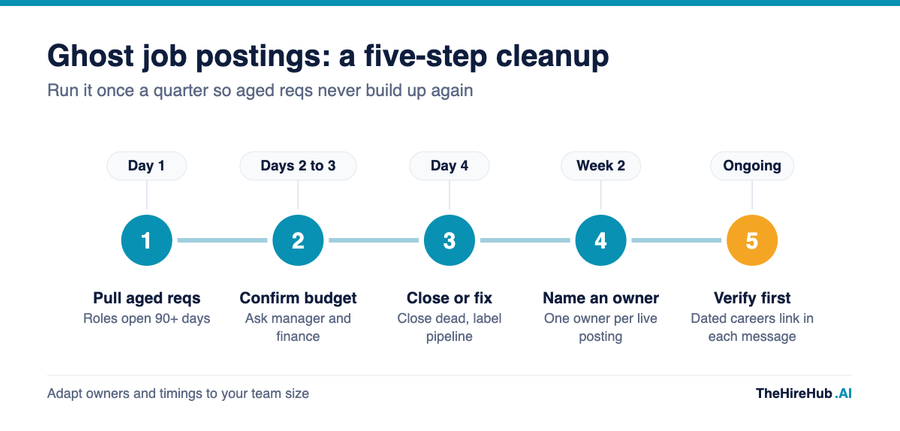
Notice that the first two steps cost almost nothing in tooling. They take a conversation with finance and the hiring manager, and that conversation is where most stale reqs actually die.
Ghost job postings vs candidate ghosting
Employer-side ghost jobs are not the same problem as candidate ghosting. Candidate ghosting happens after someone applies, in the silence after an interview or an offer. A ghost posting happens before anyone applies, when a listing promises a job nobody intends to fill.
The fixes differ too. Ghosting is solved by follow-up cadence and clear decision dates. Ghost postings are solved by req hygiene and verifiable outreach, which is why tightening follow-up alone still loses candidates who saw a stale role first.
The distinction matters for the metric you choose. If you track candidate silence, you see the symptom after the fact. If you track req age at the moment outreach starts, you see the cause, which is the point where a ghost posting does its damage. That is a measurable signal you can put on a 2027 dashboard without buying a new tool.
How to actually do this (and the four traps)
Run the cleanup in this order, and watch for these four traps.
Before you start, decide what counts as aged. Ninety days is the threshold used in the data above, but a niche executive search can legitimately run longer, so age alone is not the test. The test is whether someone can name the budget line, the hiring manager, and the next decision date for that req.
- Closing reqs without telling the hiring manager. A quiet close creates a fight later. Send one line with the req name and a reopen date before you take the posting down.
- Relabelling the status but not the copy. A pipeline flag in your ATS does nothing if the public posting still reads urgent. Make the posting match the status.
- Treating verification as a sales trick. A dated careers-page link and a named hiring manager work because they are true. Invented urgency breaks the first time a candidate checks, so watch where drop-off happens in your recruitment funnel conversion rates data.
- Skipping the quarterly sweep. One cleanup clears the backlog, but only a standing check stops the next one. When you evaluate tools, ask whether they can flag requisitions older than a set age, using our AI recruiting vendor checklist as the starting list.
"The fastest way to earn a reply is to prove the job exists before the candidate has to ask."
The one thing every hiring leader should take from this
Your 2027 plan will include a req count, and a share of those reqs will not survive a disclosure rule, a candidate's first search, or a finance review. Audit them before you forecast hiring velocity, because a stale req inflates your pipeline and depresses your reply rate at the same time.
Two things to keep in mind as you plan. First, the regulatory picture is still moving, so a req that passes today's rules may not pass a disclosure rule in another state. Second, the reply-rate gap is a signal about trust, and trust compounds: a candidate who doubts one posting extends less benefit of the doubt to your next one.
Pick one hour this week. Pull every role open 90 days or longer, call the owner of each one, and close or relabel anything you cannot defend in a sentence. If you want a second pair of eyes on the backlog, we look at this stuff all day.
Frequently Asked Questions
A posting with no active plan to hire soon, such as a frozen budget req, an evergreen pipeline listing, or a role kept live to signal growth. Greenhouse classified 18 to 22 percent of jobs on its platform this way in any given quarter in its 2024 report.
Common, from the candidate side. Greenhouse found three in five candidates suspect they have applied to one. Revelio Labs reports that hires per posting fell from 0.75 in 2018 to below 0.5 in 2023, the most recent year its series covers.
Pin reports, from a sample of 1.9 million outreach sequences created between October 2025 and August 2026, that roles open 90 days or more earned 8.4 percent replies against 11.3 percent for roles under 30 days old. That is a correlation in one vendor's data, not proof that ghosting causes the gap.
Mostly not yet. New York's S8877 passed both chambers on June 2, 2026 and would require employers with 100 or more employees to state vacancy status. In the reporting we checked it was awaiting the governor's signature, so confirm current status before you act on it.
Disclosure rules are the direction of travel, not a settled forecast. If New York's bill is signed, postings would need bold vacancy statements and removal within two weeks of a hire. New Jersey has a vacancy-disclosure bill, S2136, introduced in May 2026.
No reliable dollar figure exists for that. The cost you can measure is reply rate and recruiter time lost on dead reqs. Compare reply rates on your own reqs by age before you set a 2027 sourcing budget, and use that comparison rather than any published average.
Name the hiring manager and team, link a dated posting on your own careers site, and send from a company domain. Candidates who doubt a message often check the posting first, so make the message and the posting say the same thing.
No. Close the roles you cannot fund and relabel genuine pipeline roles so the posting says so. A 90-day req can still be a hard search, so the test is whether someone can name the budget line, the hiring manager and the next decision date.
One named person per requisition, usually the recruiter with the hiring manager signing off on funding. The goal is that the takedown has an owner, so a paused role does not stay live by default because nobody was responsible for closing it.
The mechanics are the same across Naukri, LinkedIn and company career pages: stale listings cost replies. We have not found a verified India-specific ghost-job share, so do not quote one without checking a primary source first.


