
Agency Replacement Clause in India 2026: What It Really Covers
The guarantee window expires before a replacement can start, which is why the remedy is the only part worth negotiating.
Indian agencies guarantee 60 to 90 days, but refilling a role takes 102 to 160 days. Here is what to negotiate into the clause before you sign anything.

TL;DR
The agency replacement clause is the most quoted and least read line in a recruitment contract. Most Indian contingency agencies offer a 60 to 90 day replacement guarantee, and 90 days is close to an industry standard, accounting for roughly half of all agency guarantees. The problem is arithmetic: a permanent replacement in India takes six to ten weeks to recruit and then 60 to 90 days of notice to arrive, so the guarantee window usually expires before the replacement could physically start. That does not make the clause worthless, but it does mean the remedy matters far more than the window, and most contracts are vague about exactly that. Read it alongside our India executive search fees breakdown before you sign.
What is actually happening
Guarantee periods have converged. Current agency terms cluster at 30, 60 or 90 days, with 60 to 90 days particularly prevalent for professional permanent recruitment in India. The 90 day version accounts for around half of all recruitment agency guarantees, which makes it the closest thing the profession has to a standard.
What has not converged is the remedy, and that is where the money sits. Three structures are in common use: a full refund returning 100 percent of the fee, a prorated refund scaled to how long the candidate stayed, and replacement-only, where the agency sources another candidate instead of returning anything.
Those three are not close to equivalent. Replacement-only is by far the most common and by far the weakest for the client, because it obliges the agency to try rather than to pay. If the agency cannot find a suitable replacement, a poorly drafted clause leaves you with nothing.
Enforceability is stricter than most people assume. Under the Indian Contract Act, 1872, a guarantee is enforceable only where it is written into the service agreement with a defined trigger, timeline and remedy. A verbal assurance from a business development manager is not a guarantee, and neither is a line in a proposal deck that never made it into the signed agreement.
The practical consequence is that a real replacement clause names three things explicitly. The trigger, meaning what has to happen: attrition, performance failure, or fit failure. The window, typically 90 days from joining date. And the remedy, whether that is a free replacement, a partial refund, or a fee credit.
The numbers
The reason the window matters less than it looks is that it is measured against the wrong clock. A 90 day guarantee runs from the joining date, but the replacement cycle runs on India's hiring timelines: six to ten weeks to recruit a permanent hire, then the replacement's own 60 to 90 day notice period.
Put those together and refilling a role realistically takes 102 to 160 days from the moment you start. The guarantee has expired by then in almost every case.
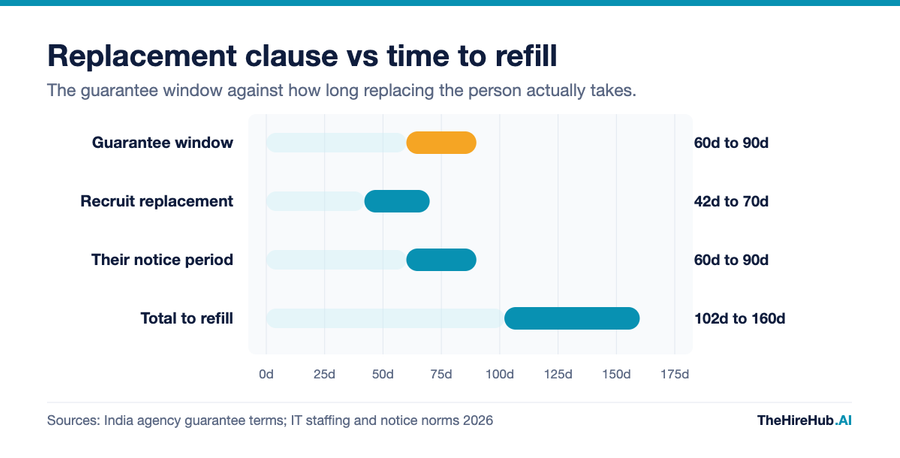
How to read this:
- The guarantee window and the refill time barely overlap. If your remedy is replacement-only, the clause is promising something the market cannot deliver inside the window.
- This is why the fallback provision is the most valuable sentence in the clause. A well drafted contract specifies a partial refund or fee credit if the agency cannot source a replacement in time.
- None of this is the agency behaving badly. It is a structural mismatch between a guarantee convention borrowed from faster markets and India's notice period reality.
There is a second reason the window is the wrong thing to argue about. Ninety days is shorter than the period in which a mishire reveals itself. A weak senior hire is rarely obvious in month one: they are still being onboarded, still being given the benefit of the doubt, and still inside the window where any struggle looks like ramp-up. The problems that matter usually surface in month four or five, by which point every guarantee on the market has lapsed. So the clause reliably covers the failures you would have spotted in the interview and reliably misses the ones you would not.
How it actually works, and where it breaks
In the normal course, the candidate resigns or is terminated inside the window, you notify the agency in writing, and the agency either restarts the search or issues a credit depending on what the contract says. The mechanics are simple. The disputes are almost always about definitions.
The first failure mode is an undefined trigger. If the clause says the guarantee applies when a candidate leaves, it is silent on termination for performance, on redundancy, and on the candidate never actually starting. Agencies will read all three in their favour, and they are not wrong to, because the contract did not say otherwise.
The second is the exclusion list. Most agency templates carve out redundancy, restructuring, role elimination and change of reporting line. Those carve-outs are reasonable in isolation, and taken together they can exclude most of the realistic reasons a new hire leaves in the first 90 days.
The third is the window's start date. A guarantee running from the invoice date rather than the joining date can lose you four to six weeks of protection, because your invoice often precedes the candidate's actual start by exactly the length of their notice period, a gap our notice period buyout guide explains in detail.
"A guarantee that only obliges the agency to try again is not a remedy, it is a promise to repeat the work that already failed."
What this means for your team
Everything worth having here is negotiated before signature, not after a candidate leaves. The sequence below is deliberately all at the contract stage, because that is the only point at which you have leverage.
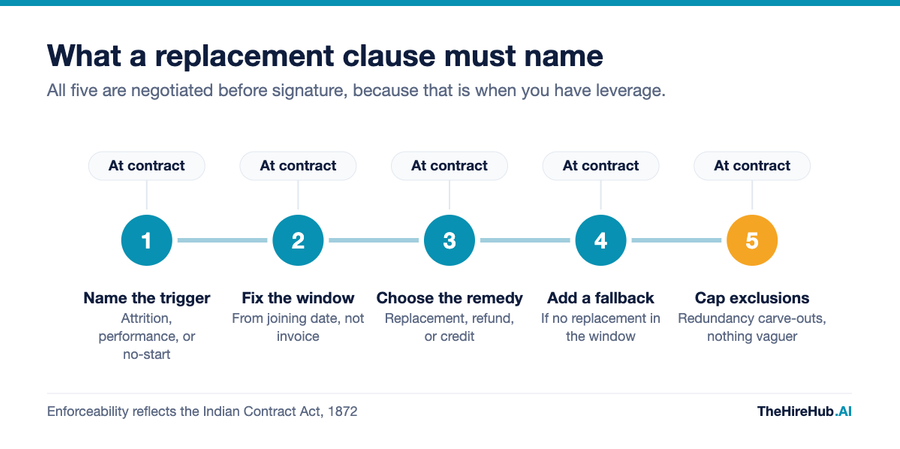
The clauses worth insisting on:
- Define the trigger to include resignation, termination for performance, and failure to start at all.
- Run the window from the joining date, in writing, never from invoice or offer date.
- Get a fallback remedy: if no suitable replacement inside a stated period, a partial refund or fee credit applies automatically.
- Cap the exclusion list. Accept genuine redundancy and restructure carve-outs, and push back on vague ones like change of business need.
- Agree the notification mechanism and deadline, so a late email cannot void an otherwise valid claim.
One practical note on volume hiring, where the calculus is different. For high-volume roles with short recruitment cycles, a replacement-only guarantee is genuinely useful, because the agency can plausibly refill inside 90 days and often inside 30. The mismatch this post describes is a senior and specialist problem, and it scales with how hard the role is to fill. If most of your hiring is high-volume and fast, the clause is doing roughly what it claims, and the flexibility question in our contract staffing versus permanent comparison probably matters more to you than the guarantee wording.
Agency replacement clause vs paying for a proper search
The replacement clause exists because contingency recruitment is transactional: the agency is paid on placement, so its risk on a bad placement is limited to doing the work again. That structure is fine for volume roles where a replacement genuinely can be sourced quickly.
It fits badly at senior level, where the mismatch between guarantee window and refill time is widest and where a bad hire does far more damage than the fee. Retained search charges more and structures the engagement differently, which changes what you are buying and what recourse you have, a comparison our executive search versus RPO piece sets out. The honest way to think about it is that a replacement clause protects the fee, not the business. The cost of a senior mishire is dominated by the damage done while the person was in the seat, which is the point of our real cost of a bad hire analysis, and no clause refunds that.
How to actually do this (and the four traps)
- Do not accept replacement-only without a fallback. An obligation to try is not a remedy. Insist that failure to place a replacement inside a stated period converts automatically into a partial refund or fee credit.
- Do not let the window start at invoice. Joining date, written explicitly. Anything else quietly hands back several weeks of cover, and in India that gap is the length of a notice period.
- Do not skim the exclusion list. Read it as a whole and ask what is actually left. If redundancy, restructure, reporting change and business need are all excluded, you are holding a guarantee against almost nothing.
- Do not rely on anything that is not in the signed agreement. Under the Indian Contract Act a guarantee needs a written trigger, timeline and remedy. Assurances in a proposal deck or an email thread are not the contract, and the cost of learning that lands in your cost per hire benchmarks.
"The replacement clause protects the fee, and the fee was never the expensive part of hiring the wrong person."
The one thing every hiring leader should take from this
Stop negotiating the length of the guarantee and start negotiating the remedy. Ninety days sounds better than sixty and makes almost no practical difference, because neither window is long enough to source and onboard a replacement in the Indian market. What does make a difference is whether a failed placement converts into money back, and whether the list of exclusions leaves anything standing. Ask for the fallback clause in writing, and treat any refusal as information about how the agency expects this to go. If you want a second pair of eyes on an agency agreement, we look at this stuff all day.
Frequently Asked Questions
It is a contractual term stating that if a placed candidate leaves or is terminated within a defined window, the agency will source a replacement or return part of the fee. To be enforceable it needs a written trigger, timeline and remedy.
Most Indian contingency agencies offer 60 to 90 days. Ninety days is the closest thing to an industry standard and accounts for roughly half of all agency guarantees, though 30 and 60 day terms are also in use.
Three are common: a full refund returning 100 percent of the fee, a prorated refund scaled to how long the candidate stayed, and replacement-only, where the agency sources another candidate rather than returning money.
Only if it is written into the signed service agreement with a defined trigger, timeline and remedy, per the Indian Contract Act, 1872. Verbal assurances and claims in a proposal deck that never entered the contract are not enforceable.
Because refilling a role in India realistically takes 102 to 160 days: six to ten weeks to recruit plus the replacement's own 60 to 90 day notice period. The guarantee window usually expires before a replacement could start.
Always from the joining date, stated explicitly. A window running from invoice date can lose you four to six weeks of protection, because the invoice often precedes the actual start by the length of the candidate's notice period.
It is the provision that applies if the agency cannot source a suitable replacement inside the guarantee window, commonly a partial refund or a fee credit. It is the single most valuable sentence in the clause and is frequently missing.
Typically redundancy, restructuring, role elimination and change of reporting line. Each is reasonable alone, but together they can exclude most of the realistic reasons a new hire leaves within the first 90 days.
Only if the contract says so. A clause worded around a candidate who leaves is silent on a candidate who accepts and then does not join, so the trigger should name failure to start explicitly.
Volume. For high-volume roles with short recruitment cycles an agency can plausibly refill inside the window. At senior level the gap between guarantee window and refill time is widest, so the remedy matters far more than the window.


