
Diversity Hiring in India 2026: The Conversion Gap Nobody Measures
The qualified pipeline already exists, which makes this a process problem rather than a supply problem.
Women are 43 percent of India's STEM graduates and about 27 percent of its STEM workforce. That gap is conversion loss, and it sits inside processes you control.

TL;DR
Diversity hiring in India grew 21 percent year on year in May 2026 even as overall hiring cooled, which tells you it has stopped being a discretionary programme and started being a sourcing strategy. Women accounted for 56 percent of all diversity-focused hires. But the number worth staring at is the leak, not the intake: women are 43 percent of India's STEM graduates and only around 27 percent of the STEM workforce. That gap is not a pipeline problem, because the pipeline exists. It is a conversion and retention problem, which is a different thing to fix and considerably less flattering. Start by instrumenting your own funnel the way our AI hiring metrics breakdown sets out.
What is actually happening
The direction of travel is genuinely positive and the timing is the interesting part. Diversity-focused hiring in India rose 21 percent year on year in May 2026 during a period when overall hiring was cooling. Programmes that are cosmetic get cut first in a slowdown, so growth against that backdrop suggests companies are treating it as a talent supply decision.
Sector leadership is not where most people would guess. BFSI leads, with women making up 62 percent of its diversity-focused recruitment, and BFSI, FMCG and healthcare all exceed 60 percent representation in their diversity hiring pools.
IT software and services is the largest absolute recruiter of diverse talent at 25 percent of all such hires, which reflects its size rather than its rate. Volume leadership and rate leadership are different claims, and they get conflated constantly in vendor marketing.
The macro picture has improved substantially and is easy to understate. Female labour force participation in India rose from 23 percent in 2017-18 to around 42 percent in 2023-24. That is a large move in six years by any international standard.
The counterweight is where the participation sits. Women aged 25 and above holding advanced degrees make up only 2.9 percent of the employed female workforce across rural and urban India. Participation has grown considerably faster than qualified, senior participation has.
The numbers
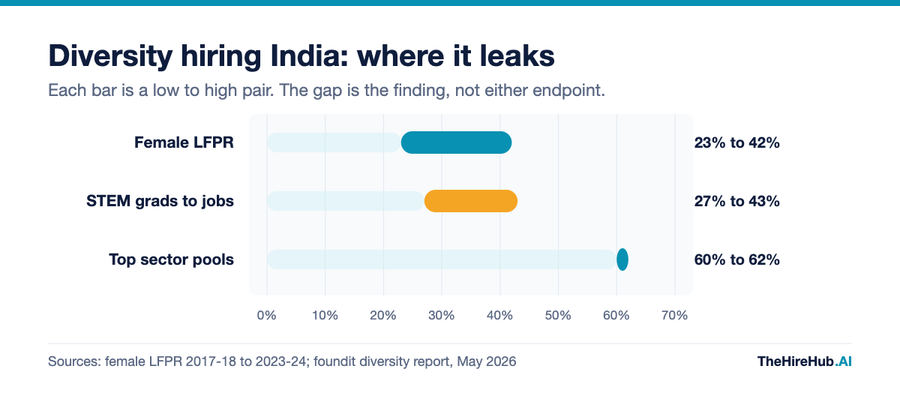
The three bands below are all low-to-high pairs, and in each case the gap is the finding rather than either endpoint. Female labour force participation moved from 23 to 42 percent across six years. The STEM band shows 43 percent of graduates against roughly 27 percent of the workforce. The sector band shows the top performers clustered at 60 to 62 percent of their diversity hiring pools.
How to read this:
- The STEM gap is the actionable one. A 16 point drop between graduating and working is conversion loss, and it happens inside processes companies control.
- The participation gain from 23 to 42 percent is real but concentrated in lower-paid and informal work, which is why the advanced-degree figure sits at 2.9 percent.
- Sector numbers describe the composition of diversity hiring pools, not overall workforce composition. A high figure means the diversity pipeline is female-weighted, not that the company is 62 percent women.
One more distinction is worth drawing, because it changes what you should measure. Diversity in India is not only a gender question, even though gender is where almost all the published data sits. Regional and language background, first-generation graduates, tier-two and tier-three college hiring, and candidates from non-elite institutions all shape who ends up in a shortlist, and none of them show up in the 56 percent figure. A company that hires women exclusively from the same six metros and the same twelve colleges has improved one axis and left the others untouched. Automated screening can either help with this or entrench it, depending entirely on what the model learned from, which is the subject of our AI bias free hiring guide.
How it actually works, and where it breaks
Most Indian diversity programmes are built at the top of the funnel: targeted job ads, women-only hiring drives, returnship programmes, partnerships with women's colleges. These work, in the narrow sense that they increase applications from women.
The first failure mode is that top-of-funnel effort does nothing about mid-funnel conversion. If women apply at 40 percent and get hired at 20 percent, adding applicants scales the loss rather than fixing it. Almost nobody measures pass-through rates by gender at each stage, so the leak stays invisible and the programme keeps buying applicants.
The second is the unstructured interview. Where interviewers ask different questions of different candidates and score on impression, the outcome tracks similarity to the interviewer. Structured interviews with a fixed rubric are the single most effective intervention available here, and they are cheap, which is the argument our structured hiring in India guide makes in general terms.
The third is the returnship trap. Hiring women after a career break and then placing them into roles below their prior level, at pay below their prior band, produces good headline numbers and high attrition within eighteen months. You will hire the same person twice and count it as progress both times.
The fourth is treating a hiring target as a retention strategy. If the environment that produced 27 percent STEM participation is unchanged, people hired into it leave at the rate the environment produces. Intake targets with no retention measurement generate churn that looks like success in the quarterly report.
"Adding applicants to fix a conversion problem does not close the gap, it just scales the loss and makes the reporting look busy."
What this means for your team
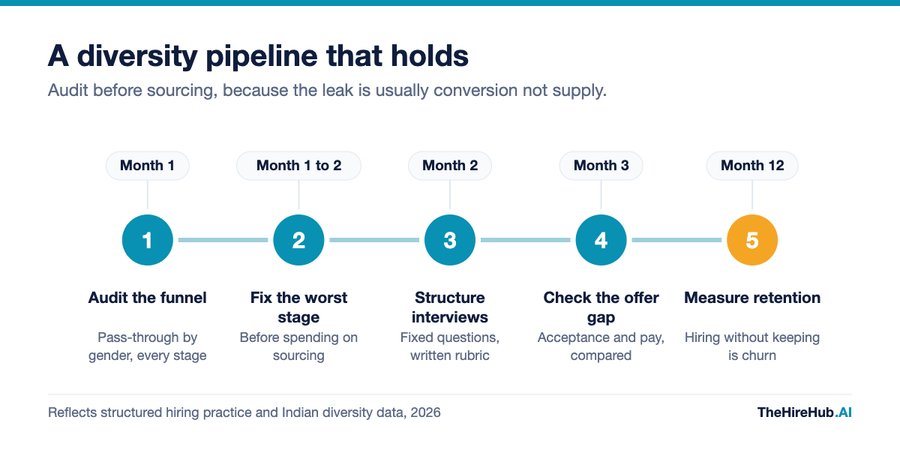
The sequence below deliberately starts with the funnel audit rather than with sourcing, because until you know which stage leaks you cannot tell whether you have a supply problem or a conversion problem. Most teams assume supply and it is usually conversion.
The operating rules that make this hold:
- Measure pass-through by gender at every stage: applied, screened, interviewed, offered, accepted, still here at twelve months.
- Fix the stage with the steepest drop before spending anything on sourcing.
- Use a fixed question set and a written rubric for every interview at the same level.
- Track offer acceptance by gender separately. A gap there usually means a pay or a role-framing problem, which is visible against your offer acceptance rate baseline.
- Report twelve month retention alongside hiring numbers, always, in the same view.
There is a sequencing point buried in that list. Retention measurement is last in the order of work but first in the order of consequence: a team that hires well and keeps badly will spend the following year re-running the same searches, at full cost, while reporting progress. Twelve months is the minimum useful window, and eighteen is better for roles with long ramp periods.
Diversity hiring vs diversity targets
A target is a number. A hiring strategy is a mechanism. Conflating them is the most common failure in this area, and it produces the specific pathology of a company that hits its intake percentage every year while its senior composition never changes.
Targets do useful work when they are attached to a diagnosis. If your funnel audit shows women dropping out between screen and first interview, a target for that stage with a named owner is a real intervention. A company-wide percentage with no stage-level diagnosis just pushes recruiters toward whatever is easiest to move, which is usually junior intake, because junior roles are plentiful and fast. That is how organisations end up with strong numbers at entry level and nothing above it, and why sourcing breadth matters as much as sourcing volume, a point our candidate sourcing strategies guide covers.
How to actually do this (and the four traps)
- Do not add applicants to fix a conversion problem. If your hire rate for women is half your application rate, more applications multiply the loss. Audit the funnel by stage first, then spend.
- Do not run unstructured interviews and expect fair outcomes. Impression-based scoring reliably favours candidates who resemble the interviewer. A fixed question set and a written rubric cost nothing and move outcomes more than any sourcing spend.
- Do not use returnships to hire people back at a lower level. Placing experienced women below their prior band produces attrition inside eighteen months and teaches your network exactly what the programme is worth.
- Do not report intake without retention. Hiring and keeping are different achievements. Quoting one and not the other is how a churn problem gets presented as a diversity success for three years running.
"Hiring and keeping are different achievements, and quoting the first without the second is how churn gets presented as progress."
The one thing every hiring leader should take from this
India does not have a shortage of qualified women in technical fields: 43 percent of STEM graduates are women. It has a conversion and retention problem that runs through interview processes, promotion decisions and working conditions that individual companies control. The useful consequence is that this is fixable without waiting for the macro picture to change, and the first step costs nothing except the discipline to measure pass-through by stage and look honestly at where the drop is. Do that before you approve another sourcing budget. If you want help reading your own funnel, we look at this stuff all day.
Frequently Asked Questions
Diversity-focused hiring rose 21 percent year on year in May 2026, during a period when overall hiring was cooling. Women accounted for 56 percent of all diversity-focused hires.
BFSI leads, with women at 62 percent of its diversity-focused recruitment. BFSI, FMCG and healthcare all exceed 60 percent representation in their diversity hiring pools. IT software and services is the largest recruiter by volume at 25 percent of all such hires.
It rose from 23 percent in 2017-18 to around 42 percent in 2023-24. Projections suggest participation reaching about 55 percent by 2050 would be significant for sustaining GDP growth.
Women make up 43 percent of India's STEM graduates but only around 27 percent of the STEM workforce. The shortfall is conversion and retention rather than supply, and it happens inside hiring and promotion processes companies control.
Not at graduate level. With women at 43 percent of STEM graduates, the qualified pipeline exists. The loss occurs between graduating and working, and then again through attrition, which makes it a process problem rather than a supply problem.
Measure pass-through by gender at each stage: applied, screened, interviewed, offered, accepted, and still employed at twelve months. Intake percentages alone hide where candidates are dropping out.
Yes, and they are the cheapest effective intervention available. Unstructured, impression-based scoring tends to favour candidates who resemble the interviewer, while a fixed question set and written rubric reduce that effect.
It is hiring women back after a career break but placing them below their previous level and pay band. It produces good intake numbers and high attrition within about eighteen months, so the same person is effectively hired twice.
Only when attached to a stage-level diagnosis. A company-wide percentage with no diagnosis pushes recruiters toward whatever is easiest to move, usually junior intake, producing strong entry-level numbers and no change in senior composition.
No. Regional and language background, first-generation graduates, and hiring from tier-two and tier-three institutions all shape shortlists, and none of them appear in gender statistics. A company can improve one axis while leaving the others untouched.


