
Counter Offer in India 2026: What It Buys and What It Costs
A counter offer is a financing decision, not a retention strategy, and the numbers say what you are actually buying.
Around 65 percent of Indian professionals receive a counter offer on resigning and 80 percent of those who accept leave within 18 months. Here is the real maths.

TL;DR
A counter offer in India is now the default response to a resignation rather than an exception: around 65 percent of Indian professionals report receiving one when they resign, and 85 percent of employers say they have extended one in the past year. It usually works, briefly. Roughly 55 percent of people who receive a counter offer accept it, and about 80 percent of those who accept leave within 18 months anyway. That is not necessarily a bad trade, because replacing a mid-senior professional in India costs 50 to 150 percent of their annual salary, but it is only a good trade if you know you are buying time rather than loyalty. The economics are easier to see next to your cost per hire benchmarks.
What is actually happening
The counter offer has moved from a last resort to a standard retention reflex, and the volume tells you why. Robert Half's 2026 Salary Guide found that 85 percent of employers had extended a counter offer to an employee with an external offer in the previous year, while 39 percent still described counter offers as a valuable tool for retaining top talent.
In India the practice is concentrated where replacement is hardest. Around 65 percent of Indian professionals say they received a counter offer on resigning, with IT and finance reporting the highest rates. Those are the sectors where notice periods are longest and specialist replacement takes the most time.
The acceptance rate is high enough to keep the habit alive. Roughly 55 percent of employees who receive a counter offer take it, which from the employer's side looks like a coin flip that costs one salary adjustment.
The durability is where it falls apart. Around 80 percent of professionals who accept a counter offer leave within 18 months. Employers see a compressed version of the same pattern: 32 percent report that the counter-offered employee left within 12 months regardless.
The reason is not mysterious. People rarely interview because of pay alone, so a pay correction addresses the most visible symptom and none of the cause. The manager, the scope, the progression path and the commute are all still exactly as they were on the morning the person started looking.
There is one more dynamic worth naming, because it is specific to the Indian market. Long notice periods mean a resignation gives the employer 60 to 90 days of warning, which is unusually generous by global standards. That window is exactly what makes the counter offer feel low risk: there is time to negotiate, time to plan, and time to reverse course. It also means teams that do nothing for the first six weeks of a notice period and then panic into a counter offer in week ten have wasted the one structural advantage they had.
The numbers
The case for counter offers is almost entirely a replacement-cost argument, so it is worth putting real figures against it. Gallup's turnover benchmarks put replacement at 50 to 200 percent of annual salary depending on role and seniority, with entry-level and non-skilled roles at the lower 30 to 50 percent band. For mid-senior professionals in India the working range is 50 to 150 percent.
The agency fee is the part people quote, and it is the smallest component. Conventional permanent placement in India runs roughly 8.33 to 16.67 percent of annual CTC, with specialist and senior mandates higher.
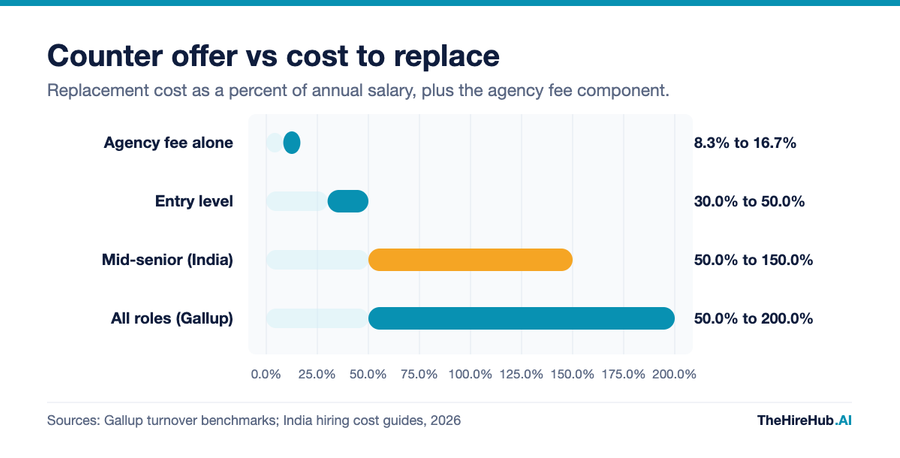
How to read this:
- The agency fee is a fraction of true replacement cost. The rest is lost productivity, interviewer time, onboarding, and the ramp period before the replacement is net positive.
- The mid-senior band is wide because it is dominated by how long the seat stays empty, not by recruitment spend.
- Against any of these bars, a 15 to 25 percent salary correction is cheap. That is exactly why counter offers are so common, and exactly why they get made without a plan.
How it actually works, and where it breaks
Mechanically the counter offer is straightforward: the employee presents an external offer, the employer matches or beats the cash component, and the resignation is withdrawn. The speed is the attraction, because it resolves in days what a replacement search resolves in months.
The first failure mode is treating pay as the diagnosis. If the person was looking because their manager is difficult or because the next role up does not exist, the raise buys quiet rather than commitment, and the search resumes once the awkwardness fades.
The second is the precedent. A counter offer that visibly works teaches the rest of the team the mechanism for getting a raise, which is to interview elsewhere and come back with paper. Organisations that do this repeatedly end up with a compensation structure shaped by who was willing to threaten to leave.
The third is the trust cost on both sides. The employee has signalled they were willing to go, and that tends to sit quietly in succession and promotion decisions afterwards. Meanwhile the employee knows their raise required leverage, which is corrosive in a different direction.
The fourth is the one that actually hurts: most teams stop the backfill planning the moment the resignation is withdrawn. Given that 80 percent leave inside 18 months, cancelling the pipeline is the single most expensive part of the whole exercise.
"A counter offer does not solve the problem that made someone interview elsewhere, it just puts a price on postponing it."
What this means for your team
The sequence below is the employer-side version, and the structure matters. Every step before the offer is about deciding whether to make one at all, and the final step assumes you will need a replacement regardless.
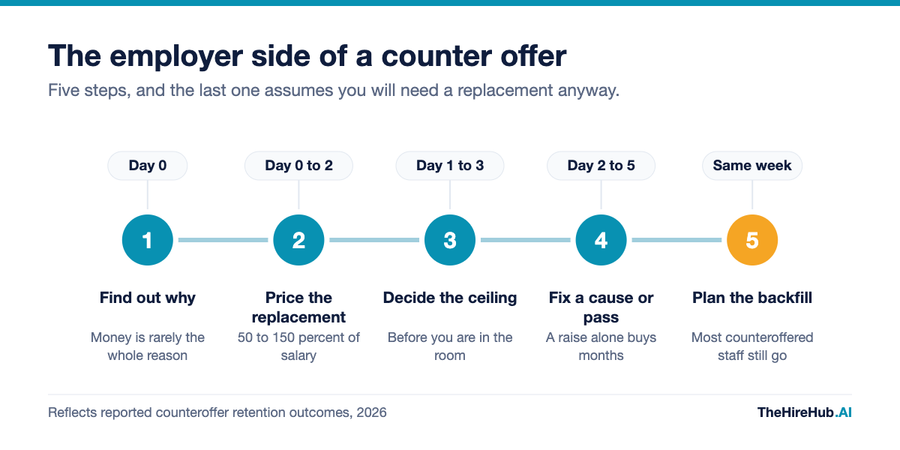
The rules that make this defensible:
- Find out why they were looking before you talk about money, and do it in a conversation you are not simultaneously negotiating in.
- Set your ceiling before the meeting, priced against replacement cost rather than against the competing offer.
- Do not counter for a role you were already planning to restructure. You will pay twice.
- If you counter, fix at least one non-cash cause in the same conversation, with a date attached.
- Keep the backfill pipeline warm. Treat the retention as a 12 to 18 month extension, not a resolution.
The other half of the picture is what you do with the resignations you decide not to counter. A clean, well-handled exit is a recruiting asset: people who leave on good terms refer candidates, come back as boomerang hires, and speak accurately about the company to their network. Teams that treat every resignation as a betrayal forfeit all of that, and the effect is measurable in how hard sourcing becomes eighteen months later. Tracking where your accepted offers actually come from, as in our offer acceptance rate guide, usually shows how much of the pipeline is referral-shaped.
Counter offer vs letting them go and rehiring
The honest comparison is not counter offer against loyalty, it is counter offer against a replacement search with a known cost and a known duration. Priced that way, the counter offer wins more often than its reputation suggests, particularly for a person holding critical context or sitting on a long notice period that would delay their replacement further, a constraint our notice period buyout guide covers in detail.
Where it loses is when the role was overdue for change. If the scope has drifted, if the level is wrong, or if the person was a marginal performer whose departure would have been a quiet relief, a counter offer converts a free correction into a paid delay. Senior mandates deserve particular scrutiny here, because the replacement economics look different once search fees enter the picture, as set out in our India executive search fees breakdown.
How to actually do this (and the four traps)
- Do not counter before you have diagnosed. Money is the reason people give, not usually the reason they went looking. A raise attached to no other change is a scheduled repeat of the same conversation.
- Do not let the external offer set your number. Matching a competitor's figure imports their compensation logic into your structure. Price against what replacement would cost you and cap it there.
- Do not cancel the backfill. With 80 percent gone inside 18 months, the pipeline you stand down in relief is the pipeline you will rebuild from zero under pressure. Treat the counter offer as a runway extension.
- Do not make it invisible. An off-books adjustment to stop one resignation creates a pay anomaly that surfaces at the next review cycle and damages more trust than it saved, which is the sort of quiet cost that compounds the same way a mishire does, as in the real cost of a bad hire.
"If you would not have given the raise last month, you are not retaining an employee, you are paying a resignation fee."
The one thing every hiring leader should take from this
A counter offer is a financing decision, not a retention strategy. You are borrowing 12 to 18 months of continuity at the price of one salary correction, and that can be a genuinely good deal when the seat is critical and the replacement is slow. It stops being a good deal the moment you believe you have solved something. Make the offer with the backfill plan already running, fix at least one thing that is not money, and put a date in the calendar to check whether it held. If you want a second view on whether to counter or replace, we look at this stuff all day.
Frequently Asked Questions
Very common. Around 65 percent of Indian professionals report receiving a counter offer when they resign, with IT and finance the highest. On the employer side, Robert Half's 2026 Salary Guide found 85 percent had extended one in the previous year.
Roughly 55 percent of employees who receive a counter offer accept it. Acceptance is highest where the person's concerns are genuinely pay-led and lowest where the reason for leaving was the manager or the scope of the role.
Only in the short term. About 80 percent of professionals who accept a counter offer leave within 18 months, and 32 percent of employers report the person left within 12 months. They buy time rather than resolving the underlying reason.
Gallup puts replacement at 50 to 200 percent of annual salary depending on role and seniority. For mid-senior professionals in India the working range is 50 to 150 percent. Entry level and non-skilled roles sit lower at 30 to 50 percent.
Usually yes, in pure cash terms. A 15 to 25 percent salary correction is far less than a replacement costing 50 to 150 percent of salary. The correct comparison is against replacement cost, not against the competing offer.
Conventional permanent placement runs roughly 8.33 to 16.67 percent of annual CTC, where 8.33 percent is equivalent to one month's salary. Specialist and senior mandates command higher percentages.
Yes. Given that around 80 percent of counter-offered employees leave within 18 months, standing down the backfill pipeline is the most expensive mistake in the process. Treat the retention as a runway extension.
Because pay was rarely the actual reason they started looking. The manager, the scope, the progression path and the working pattern are unchanged, so the original motivation returns once the immediate awkwardness passes.
It can. A visible, successful counter offer teaches the team that the route to a raise is an external offer, which over time shapes pay structure around who was willing to threaten to leave rather than around contribution.
Diagnose first, in a conversation separate from any negotiation. If the cause is fixable and not money, fix that with a date attached. If the role was overdue for restructuring, a resignation is a free correction and a counter offer converts it into a paid delay.


