Agentic AI vs RPA in Recruiting 2026: Why Rule-Based Automation Falls Short
RPA automates the steps you can script. Agentic AI runs the whole hiring workflow, decides what to do next, and adapts when reality doesn't match the script.
Agentic AI vs RPA in recruiting for 2026: the core difference, why rule-based automation falls short, the real use cases, and how to choose the right one.

- 1What is RPA in recruiting?
- 2What is agentic AI in recruiting?
- 3Agentic AI vs RPA: the core difference
- 4Why rule-based automation falls short in hiring
- 5Where RPA still wins
- 6Agentic AI recruiting use cases
- 7RPA vs agentic AI vs AI agents: clearing up the terms
- 8Can RPA and agentic AI work together?
- 9How to choose: a recruiter's checklist
- 10The bottom line
RPA automates tasks. Agentic AI automates outcomes. RPA follows fixed rules (post the job, sync the ATS, send the status email) and breaks the moment a field or a step changes. Agentic AI takes a goal, then plans, acts, and adapts across the whole hiring workflow with no script for every branch. In recruiting the split is clean: RPA still wins the stable, high-volume plumbing, while agentic AI handles the judgment work, from sourcing and screening to candidate conversations and the endless rescheduling. Rule-based automation has not died, it has just hit its ceiling, because hiring is a stream of judgment calls, not a fixed process. The teams pulling ahead in 2026 run both, with agentic AI orchestrating and RPA doing the repetitive lifting. New to this? Start with our AI recruitment software guide, or see how AI is already delivering 70% faster hiring.
What is RPA in recruiting?
RPA is rule-based software automation. You record or define a sequence of steps, and a bot repeats them precisely: log into the job board, paste the description, publish, then update a spreadsheet. It is deterministic, which is its strength and its ceiling. RPA does exactly what you told it to do, every time, with no understanding of why.
In a hiring context, RPA typically handles: pushing a requisition to multiple job boards, moving candidate records between systems, triggering templated emails on a stage change, and generating standard reports. If the inputs are clean and the process never varies, RPA is fast, cheap, and reliable.
What is agentic AI in recruiting?
Agentic AI is goal-driven rather than step-driven. You give it an objective and a set of tools (your ATS, a calendar, an email inbox, a sourcing database), and the agent decides the sequence itself, reasons about ambiguous inputs, and adjusts when something unexpected happens. It can read a messy resume, infer that a candidate's title does not match their actual experience, and still route them correctly.
The practical difference is autonomy under uncertainty. An RPA bot handed a resume in an unexpected format throws an error. An agent handed the same resume interprets it, asks a clarifying question if needed, and keeps the workflow moving. This is why the category is often discussed alongside AI agents in recruitment, and why it changes what "automation" even means for a talent team.
Agentic AI vs RPA: the core difference
Seven dimensions separate the two, and every one of them matters in a hiring context.
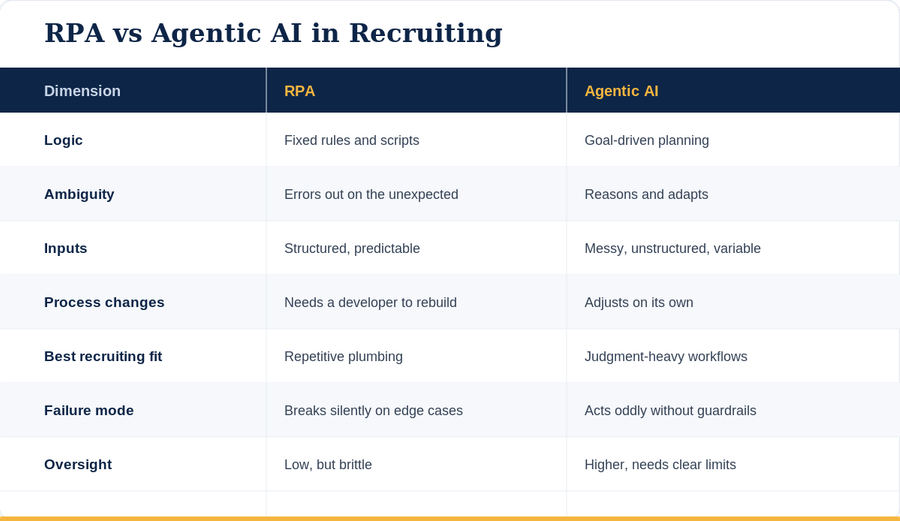
- Logic: RPA runs on fixed rules and scripts. Agentic AI plans toward a goal.
- Ambiguity: RPA errors out on anything unexpected. Agentic AI reasons and adapts.
- Inputs: RPA needs structured, predictable data. Agentic AI handles messy, unstructured, variable inputs.
- Process changes: RPA needs a developer to rebuild it. Agentic AI adjusts on its own.
- Best recruiting fit: RPA suits repetitive plumbing. Agentic AI suits judgment-heavy workflows.
- Failure mode: RPA breaks silently on edge cases. Agentic AI can act unpredictably without guardrails.
- Oversight: RPA needs little oversight but is brittle. Agentic AI needs more review and clearer limits.
The short version: RPA automates tasks, agentic AI automates outcomes. That distinction is the whole reason rule-based automation hits a wall in hiring.
Why rule-based automation falls short in hiring
Recruiting looks like a process, but it behaves like a series of judgment calls. That is exactly where fixed rules fail.
- Candidates do not arrive in a fixed format. Resumes, portfolios, and profiles are wildly inconsistent, which is exactly why AI resume parsing is so hard to do with rules alone. RPA needs structure it rarely gets, so every non-standard input becomes an exception a human has to handle.
- The best next step is not always the same step. A strong candidate who goes quiet needs a different action than a weak one who replies fast. RPA cannot tell the difference, so it treats everyone like the template.
- Processes change constantly. Job boards redesign, an ATS ships an update, a hiring manager changes the brief mid-search. Each change can silently break an RPA bot until someone notices the pipeline stalled.
- Screening is nuance, not keyword matching. Rule-based filters reward the candidates who gamed the keywords and reject the ones who did not. Real screening needs to weigh context, which scripts cannot do. Our breakdown of what AI screening actually measures shows how far this goes beyond rules.
- Coordination is chaotic. Scheduling across candidates, panels, and time zones involves constant renegotiation. RPA can send an invite, but it cannot handle the reschedule that follows, which is where most recruiter time actually goes.
Where RPA still wins
Agentic AI is not a replacement for everything, and pretending otherwise is how teams overspend. RPA remains the better tool when the work is stable, repetitive, and compliance-sensitive: syncing systems of record, posting to fixed job boards, generating the same weekly report, and moving data where you need a fully predictable, auditable path. For those tasks you often do not want an agent making decisions. You want the same action, identically, every time. The smart 2026 architecture is not RPA or agentic AI. It is knowing which one owns which task.
Agentic AI recruiting use cases
This is where agentic AI earns its place, because each of these workflows is judgment under messy inputs.
Sourcing. Instead of a static Boolean string, an agent iterates: it searches, evaluates fit, refines the query based on what it found, and builds a shortlist, closer to how a researcher works than how a bot runs. See our AI candidate sourcing guide for how this plays out end to end.
Screening at volume. The right AI screening tools can read and contextualize thousands of applications, surfacing the genuinely relevant few, which is the whole premise behind screening 1,000 candidates with AI without a rules engine collapsing under the edge cases.
Candidate communication. Agents answer questions, nudge quiet candidates differently from engaged ones, and keep momentum, rather than firing the same templated email at everyone.
Interview scheduling. This is the classic RPA failure point. An agent handles the back-and-forth, the reschedules, and the panel conflicts instead of just sending one invite and stopping, as our AI interview scheduling setup guide walks through.
Pipeline hygiene. Agents keep records current, flag stalled candidates, and prompt the next action, closing the gap between what your ATS says and what is actually true.
RPA vs agentic AI vs AI agents: clearing up the terms
These three get blurred constantly. RPA is rule-based task automation with no intelligence. An AI agent is a single autonomous unit that can perceive, reason, and act toward a goal. Agentic AI is the broader system, often multiple agents coordinating, plus the reasoning layer that plans across a whole workflow. In plain terms: RPA is the hands, an AI agent is one smart worker, and agentic AI is the team plus the manager. A modern recruiting stack usually blends all three.
Can RPA and agentic AI work together?
Yes, and in practice they should. The most robust setups let agentic AI own the decisions and orchestration while RPA executes the deterministic, high-volume steps underneath. The agent decides who to advance and what to say. RPA reliably writes that decision back to every system. You get judgment where you need it and predictability where you need that instead. Treat them as layers, not rivals.
How to choose: a recruiter's checklist
Before you buy anything, run the workflow through four questions. First, is the input predictable or messy? Predictable favors RPA, messy favors agentic AI. Second, does the task need a judgment call, or the same action every time? Judgment favors agentic AI. Third, how often does the process change? Frequent change punishes RPA. Fourth, what is the cost of a wrong autonomous decision, and can you put a human in the loop where it matters? Score each core workflow this way and you will usually find a split: agentic AI for sourcing, screening, and coordination, RPA for the plumbing. When you are ready to compare tools and pricing, the AI recruitment ROI calculator guide will keep the business case honest.
The bottom line
Rule-based automation did not fail because it was bad. It failed because hiring is not a fixed process, it is a stream of judgment calls on messy inputs, and rules cannot bend. RPA still has a real job in the stable, repetitive layer of your stack. But the parts of recruiting that actually consume a team's time, sourcing, screening, conversations, and coordination, are exactly the parts that need something that can adapt. In 2026 the winning teams are not choosing between RPA and agentic AI. They are deploying both, deliberately, and letting each do what it is genuinely good at. If you want a second opinion on your stack, we look at this stuff all day.
Secure Your Competitive Edge with TheHireHub.ai
By harnessing AI through TheHireHub.ai, HR leaders can eliminate the pain of losing top talent, slash time-to-fill and vacancy costs, and drive organizational success. Visit thehirehub.ai today to schedule a demo and experience 70% faster hiring tailored to your needs. Transform recruitment from a cost center into a strategic advantage. Start now. Curious how this works inside a real product? Explore TheHireHub's agentic AI recruiting and see how it compares.
Sign up free on TheHireHub →
Frequently Asked Questions
RPA follows fixed, pre-programmed rules to automate repetitive tasks like posting jobs or syncing your ATS, and it breaks when inputs or processes change. Agentic AI is goal-driven: it plans, reasons, and adapts across a whole hiring workflow, which makes it far better suited to judgment-heavy work like sourcing and screening.
Not universally. Agentic AI is better for workflows that involve messy inputs and decisions (sourcing, screening, candidate communication, scheduling). RPA is better for stable, repetitive, auditable tasks. Most teams use both.
Because recruiting rarely has predictable inputs or a fixed best next step. Candidates arrive in inconsistent formats, processes change often, and screening needs nuance. Fixed rules cannot handle that variability, so they generate constant exceptions for humans to fix.
Yes. The most reliable architecture lets agentic AI make decisions and orchestrate the workflow while RPA executes the deterministic, high-volume steps. They work as layers, not competitors.
Sourcing, high-volume screening, candidate communication, interview scheduling and rescheduling, and pipeline hygiene. Each involves judgment on unstructured inputs, which is where agents outperform rules.
No. It removes repetitive coordination and first-pass screening so recruiters spend time on relationships, assessment, and closing. It changes the job rather than eliminating it.
An AI agent is a single autonomous unit that perceives, reasons, and acts toward a goal. Agentic AI is the broader system, often multiple agents plus a planning layer, coordinating across a full workflow.
No. RPA is still the right tool for stable, repetitive, compliance-sensitive tasks where you want the exact same action every time. It is just no longer the whole answer.
Ask whether the input is predictable, whether the task needs a judgment call, how often the process changes, and what a wrong autonomous decision would cost. Predictable and repetitive favors RPA; messy and judgment-heavy favors agentic AI.
It can help by evaluating context instead of rewarding keyword-stuffed resumes, but it needs oversight and testing, as we cover in AI and bias-free hiring. Autonomy without guardrails can introduce its own risks, so human review on high-stakes decisions still matters.


