AI Agents in Recruitment 2026: Smarter, Faster, Cheaper
52% of talent leaders are deploying AI agents in their teams this year.
52% of talent leaders are deploying AI agents in their teams this year. If you're still manually screening resumes or chasing interview slots, you're already behind. Here's everything you need to know — and how TheHireHub.ai gives you a head start, for free.

- 1AI Agents in Recruitment 2026:How to Hire Smarter, Faster & Cheaper
- 21. Why 2026 Is the Inflection Point for AI Recruitment
- 32. What AI Agents Actually Do in the Hiring Process
- 43. Skills-Based Hiring: The Other Massive Shift You Can't Ignore
- 54. The Real Numbers: What AI Recruitment Delivers
- 65. The Human + AI Balance: Where the Smart Money Is
- 76. How TheHireHub.ai Solves This — Right Now
- 8Ready to Hire Smarter in 2026?
- 97. Frequently Asked Questions About AI Recruitment
- 10Secure Your Competitive Edge with TheHireHub.ai
AI Agents in Recruitment 2026:
How to Hire Smarter, Faster & Cheaper
52% of talent leaders are deploying AI agents in their teams this year. If you're still manually screening resumes or chasing interview slots, you're already behind. Here's everything you need to know and how TheHireHub.ai gives you a head start, for free.
The way companies hire talent has changed more in the last 18 months than in the previous 18 years. A single shift is responsible for almost all of it: AI agents — autonomous, always-on software that doesn't just recommend actions, it takes them.
According to Korn Ferry's 2026 Talent Acquisition Trends Report, 52% of talent leaders are already planning to add AI agents to their teams this year. These aren't fancy chatbots — they source candidates, screen applications, schedule interviews, and draft outreach messages, all without a human prompting every step.
This guide breaks down exactly what's happening, why it matters, and how you can leverage AI recruitment tools today to make better hires faster and at a fraction of the cost.
Quick DefinitionAI Agents in Recruitment are autonomous software systems that can independently perform hiring tasks like sourcing, screening, scheduling, and messaging without needing a recruiter to manually trigger each step. Think of them as a digital team member who works 24/7.
1. Why 2026 Is the Inflection Point for AI Recruitment
AI has been talked about in HR circles for years. But 2026 is different. Three forces are converging at once to make this year a genuine tipping point:
📈 Adoption Has Hit Critical Mass
According to SHRM's 2026 benchmarking data, AI use across HR tasks has climbed to 43% — up sharply from 26% just two years ago. Among enterprise companies, adoption sits at 78%. This isn't experimentation anymore. This is infrastructure.
⚖️ Regulation Is Forcing Accountability
The EU AI Act's obligations for general-purpose AI systems came into force in August 2026, raising compliance expectations for every employer using hiring tech in Europe. New York City's Local Law 144 continues to require annual bias audits before deploying automated hiring tools. Choosing a compliant AI recruitment platform isn't optional — it's a legal requirement.
🤝 Candidates Expect It (Sort Of)
Here's the nuance: 82% of candidates prefer getting fast answers from AI chatbots over waiting days for a human recruiter. But only 26% trust AI to evaluate them fairly (Gartner). The winning formula is visible human oversight plus AI speed — exactly the model platforms like TheHireHub.ai are built around.
2. What AI Agents Actually Do in the Hiring Process
Let's be specific. "AI in recruitment" is a broad term that covers very different capabilities. Here's a breakdown of where AI agents are making real impact in 2026:
- 1Intelligent Sourcing — AI agents proactively search job boards, LinkedIn, GitHub, and passive talent pools to surface qualified candidates — even ones who haven't applied. Some tools now process over 100 million candidate profiles in seconds.
- 2Resume Screening & Skills Matching — Modern AI goes beyond keywords. It evaluates context, skill clusters, and transferable experience. AI screening tools now achieve up to 94% accuracy in resume parsing, according to Second Talent's 2026 statistics.
- 3Automated Interview Scheduling — No more back-and-forth emails. AI agents sync calendars, book slots, send reminders, and reschedule when conflicts arise — all automatically.
- 4Personalized Candidate Outreach — AI drafts and sends tailored messages to candidates. Companies using AI-assisted recruiter messaging are 9% more likely to make a quality hire than those who don't (LinkedIn, 2026).
- 5Predictive Analytics — AI can predict job performance with 78% accuracy and predict retention likelihood with 83% accuracy, helping you avoid costly mis-hires before the offer goes out.
- 6Bias Reduction — When properly implemented and audited, AI reduces hiring bias by 56–61% across gender, race, and educational background (Second Talent, 2026).
✅ TheHireHub.ai AdvantageTheHireHub.ai bundles all six of these capabilities into one unified platform — no patchwork of tools, no enterprise-level pricing. Start hiring with AI in minutes at thehirehub.ai.
3. Skills-Based Hiring: The Other Massive Shift You Can't Ignore
AI isn't just changing how companies hire — it's changing what they hire for. Skills-based hiring is now the dominant philosophy at forward-thinking organizations, replacing the old model of hiring based on job titles, years of experience, or degree credentials.
As TechTarget's 2026 HR Trends report notes, AI plays a central role in skills-based hiring: candidate assessments powered by AI evaluate demonstrated competencies rather than proxies for ability. This is better for companies (higher quality hires), better for candidates (fairer evaluation), and better for diversity goals.
Why It Matters for Your Pipeline
A candidate who lists "Python" on their CV might mean anything from beginner scripts to production ML pipelines. Skills-based AI assessments reveal the difference in minutes. For high-volume roles especially — customer support, sales, operations — this alone can transform your hiring quality.
⚠️ Watch Out Not all ATS platforms have kept up with skills-based hiring. If your system still filters candidates by job title matching or degree requirements alone, you're losing talent to competitors who have moved on. TheHireHub.ai's AI screening engine is built for skills-first evaluation from day one.
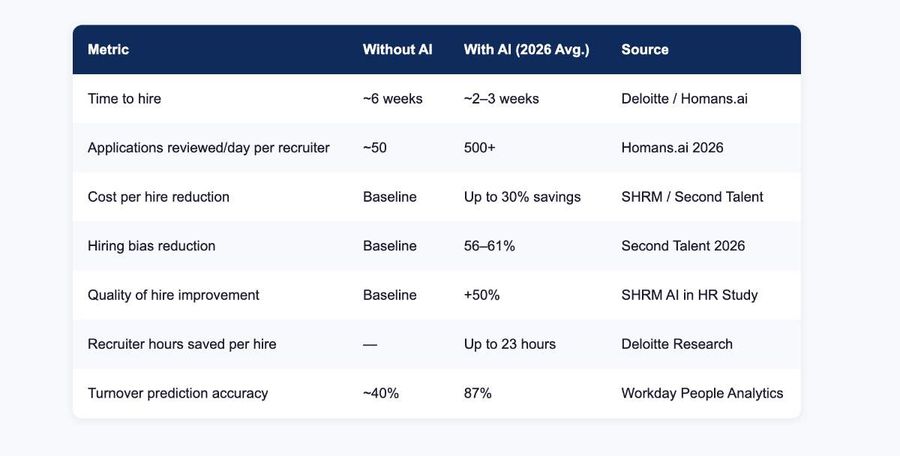
4. The Real Numbers: What AI Recruitment Delivers
If you're building a business case for AI hiring tools, here are the stats that matter — all from third-party research published in 2025–2026:
5. The Human + AI Balance: Where the Smart Money Is
One of the most important findings from SHRM's 2026 study on recruitment is that AI doesn't work in isolation. The companies seeing the biggest returns are those using AI for what it's excellent at — processing, pattern-matching, scheduling, outreach — while keeping humans in the loop for relationship-building, culture assessment, and final decisions.
The "AI Twin" Model
Recruiterflow's 2026 Trends Report describes the winning approach as building an "AI Twin" — a digital counterpart that runs all manual, repetitive tasks in the background, saving recruiters 15+ hours per week and eliminating burnout from admin overload. Your team focuses on closing the best candidates. The AI handles everything else.
🚨 The Risk of Doing NothingAccording to Korn Ferry, every new hire in 2026 carries 100x the strategic weight it did three years ago — because fewer people are being hired, and each one is amplified by technology. A wrong hire hits harder than ever. An under-resourced recruiting process is no longer just inefficient. It's a competitive liability.
6. How TheHireHub.ai Solves This — Right Now
TheHireHub.ai is built for exactly this moment. Whether you're a startup making your first 10 hires or an HR team managing hundreds of open roles, the platform delivers enterprise-grade AI hiring capability without the enterprise price tag.
What Sets TheHireHub.ai Apart
Ready to Hire Smarter in 2026?
Join thousands of HR teams already using TheHireHub.ai to cut hiring time in half, reduce bias, and find candidates who actually perform.
7. Frequently Asked Questions About AI Recruitment
What are AI agents in recruitment?
AI agents in recruitment are autonomous software systems that independently carry out hiring tasks such as sourcing candidates, screening CVs, scheduling interviews, and sending personalized outreach — without needing a human to trigger each step manually. Unlike basic automation, AI agents adapt their actions based on real-time data and context.
Is AI recruitment legal and compliant in 2026?
Yes, when used correctly. The EU AI Act (effective August 2026) and NYC Local Law 144 require employers to conduct annual bias audits and provide transparency to candidates when AI is used in hiring. Platforms like TheHireHub.ai are built with compliance tools baked in, making it easier to meet these obligations. Always ensure your AI recruitment vendor documents their bias audit procedures.
Can AI recruitment tools reduce bias?
When properly implemented and continuously monitored, yes. Research by Second Talent (2026) shows that AI screening tools reduce hiring bias by 56–61% across gender, race, and educational background. The key phrase is "properly implemented" — AI can also amplify bias if trained on historical data that reflects past discrimination. Responsible platforms include ongoing bias monitoring as a core feature.
How much does AI recruitment software cost?
Costs vary widely. Enterprise platforms from Workday or SAP SuccessFactors can cost tens of thousands annually. TheHireHub.ai offers a free tier that covers the core AI hiring workflow, with affordable premium plans for high-volume hiring teams. The ROI typically pays for itself within the first few hires due to reduced time-to-hire and lower cost-per-hire.
What is skills-based hiring and how does AI support it?
Skills-based hiring means evaluating candidates on demonstrated competencies and abilities rather than job titles or academic credentials. AI supports this by powering structured assessments, analyzing performance signals, and matching candidates to role requirements at a granular skills level — enabling fairer, more accurate hiring decisions.
How is TheHireHub.ai different from LinkedIn Recruiter or Indeed?
LinkedIn Recruiter and Indeed are primarily candidate marketplaces. TheHireHub.ai is an end-to-end AI hiring platform — it not only helps you find candidates but autonomously screens them, predicts performance, schedules interviews, reduces bias, and integrates the full workflow into one place. It's the difference between a job board and an intelligent recruiter.
Secure Your Competitive Edge with TheHireHub.ai
By harnessing AI through TheHireHub.ai, HR leaders can eliminate the pain of losing top talent, slash time-to-fill and vacancy costs, and drive organizational success. Visit thehirehub.ai today to schedule a demo and experience 70% faster hiring tailored to your needs. Transform recruitment from a cost center into a strategic advantage—start now.
Stop scrolling resumes. Start hiring.
TheHireHub's AI hands you pre-screened, ready-to-interview candidates in hours, no agency fees, no signup gauntlet.
Curious how this works inside a real product? Explore TheHireHub’s agentic AI recruiting and see how it compares.
Frequently Asked Questions
AI agents in recruitment are autonomous software systems that independently carry out hiring tasks such as sourcing candidates, screening CVs, scheduling interviews, and sending personalized outreach — without needing a human to trigger each step manually. Unlike basic automation, AI agents adapt their actions based on real-time data and context.
Yes, when used correctly. The EU AI Act (effective August 2026) and NYC Local Law 144 require employers to conduct annual bias audits and provide transparency to candidates when AI is used in hiring. Platforms like TheHireHub.ai are built with compliance tools baked in, making it easier to meet these obligations. Always ensure your AI recruitment vendor documents their bias audit procedures.
When properly implemented and continuously monitored, yes. Research by Second Talent (2026) shows that AI screening tools reduce hiring bias by 56–61% across gender, race, and educational background. The key phrase is "properly implemented" — AI can also amplify bias if trained on historical data that reflects past discrimination. Responsible platforms include ongoing bias monitoring as a core feature.
Costs vary widely. Enterprise platforms from Workday or SAP SuccessFactors can cost tens of thousands annually. TheHireHub.ai offers a free tier that covers the core AI hiring workflow, with affordable premium plans for high-volume hiring teams. The ROI typically pays for itself within the first few hires due to reduced time-to-hire and lower cost-per-hire.
LinkedIn Recruiter and Indeed are primarily candidate marketplaces. TheHireHub.ai is an end-to-end AI hiring platform — it not only helps you find candidates but autonomously screens them, predicts performance, schedules interviews, reduces bias, and integrates the full workflow into one place. It's the difference between a job board and an intelligent recruiter.


