
Series B Leadership in India 2026
Series B is where founder-led everything stops working and a real leadership layer has to take over.
Building a Series B leadership team in India 2026 means 3 to 5 senior hires at Rs 1 to 2.5 crore each. Here is the team, the full cost, and how to sequence the build.

- 1What this leadership layer actually owns
- 2Leadership comp in India 2026 (with bands)
- 3The six KPIs this leadership team is measured on
- 4When you actually need to build this layer
- 5Series B leadership vs adjacent stages
- 6How to hire (and the four traps)
- 7See how TheHireHub speeds this up
- 8The one thing every Indian CEO should take from this
- 9Secure Your Competitive Edge with TheHireHub.ai
Building out a Series B leadership team in India in 2026 means hiring three to five senior leaders whose total compensation typically lands between ₹1 crore and ₹2.5 crore each, with the full leadership layer often costing ₹6 crore to ₹12 crore a year in cash and equity. You need to start this build when the company crosses roughly ₹40 crore to ₹150 crore in revenue or 150 to 400 employees and the founders have become the bottleneck in every function. The biggest mistake is hiring all the senior leaders at once to look complete: sequence them against your actual constraint instead. Treat Series B leadership as a staged build, not a shopping list, and calibrate each seat the way you would a single CXO hire.
What this leadership layer actually owns
- Translating founder vision into systems. The Series B leadership team's core job is to take what lived in the founders' heads and turn it into processes, metrics, and teams that run without daily founder intervention. If the founders are still in every decision, the layer has not done its job.
- Owning functional numbers, not just activity. Each leader (revenue, product, finance, people, engineering) takes a number and a forecast off the founders' plate. Collectively they make the company forecastable, which is exactly what Series B investors paid for.
- Building the next layer of management. Series B leaders are measured on the managers they hire beneath them. A leadership team that cannot build a second layer creates a company where everything still funnels through five people instead of two.
- Installing the operating cadence. Weekly business reviews, quarterly planning, and the metrics that make performance visible all get built here. The cadence is what lets a 300-person company move with intent rather than drift.
- Protecting culture through hypergrowth. Headcount often doubles between Series B and C. The leadership layer owns hiring bars, values, and the hard calls that keep culture intact while the org explodes in size.
Leadership comp in India 2026 (with bands)
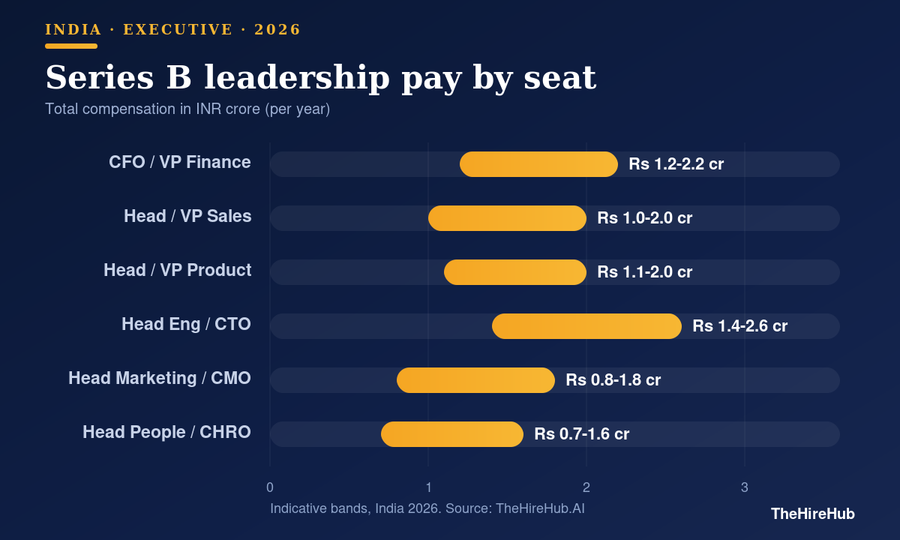
At Series B, compensation is best read by seat rather than by stage, since the stage is fixed. The figures below are total compensation (fixed plus variable plus the cash value of equity) for full-time leaders at a venture-backed Series B company in a metro hub. Equity is a meaningful slice and should be weighed alongside cash.
Chief Financial Officer or VP Finance: ₹1.2 crore to ₹2.2 crore. The first true finance leader who owns the model, the board reporting, and fundraising readiness. See our CFO hiring guide.
Head or VP of Sales or revenue leader: ₹1 crore to ₹2 crore on-target, heavily weighted to variable against the number. Detail in our VP of Sales guide.
Head of Product or VP Product: ₹1.1 crore to ₹2 crore for a leader who owns the roadmap and the outcomes, not just delivery (see the Head of Product guide).
Head of Engineering or CTO-level leader: ₹1.4 crore to ₹2.6 crore, often the most expensive seat, covered in our Head of Engineering guide.
Head of Marketing or CMO: ₹80 lakh to ₹1.8 crore, owning pipeline and positioning (see the Head of Marketing guide).
Head of People or CHRO: ₹70 lakh to ₹1.6 crore, owning the hiring engine and culture as headcount scales.
Calibration points to keep in mind:
- Budget the leadership layer as a system, not a series of one-off hires. Five senior leaders at ₹1.2 crore to ₹2 crore each is a ₹6 crore to ₹12 crore annual commitment before their teams, so sequence it against runway.
- Equity discipline matters most here. Series B leaders should take meaningful equity, and a candidate who only optimises for cash is often the wrong bet for a company still proving its scale.
- Do not over-level for prestige. A leader who thrives at ₹500 crore revenue may flounder building from ₹50 crore. Hire for the next two years of scale, not the logo on the CV.
The six KPIs this leadership team is measured on
- Forecast accuracy across functions. Whether the leadership team collectively delivers a plan the board can bank. The single clearest sign that the layer has taken control from the founders.
- Revenue growth against plan. The headline outcome Series B capital is meant to buy, owned by the revenue leader but enabled by the whole team.
- Burn multiple and capital efficiency. How much the company burns to add a rupee of new revenue. A leadership team that grows efficiently extends runway and improves the next round, which a VP of Finance will track closely.
- Second-layer hiring and bench strength. How many capable managers the leaders have built beneath them. This is what turns a founder-dependent company into a durable one.
- Time-to-productivity for new hires. As headcount scales fast, how quickly new people contribute reflects whether onboarding, process, and management are actually working.
- Leadership and key-talent retention. Whether the team you built stays through the hardest growth years. Churn at the top resets momentum and spooks both employees and investors.
When you actually need to build this layer
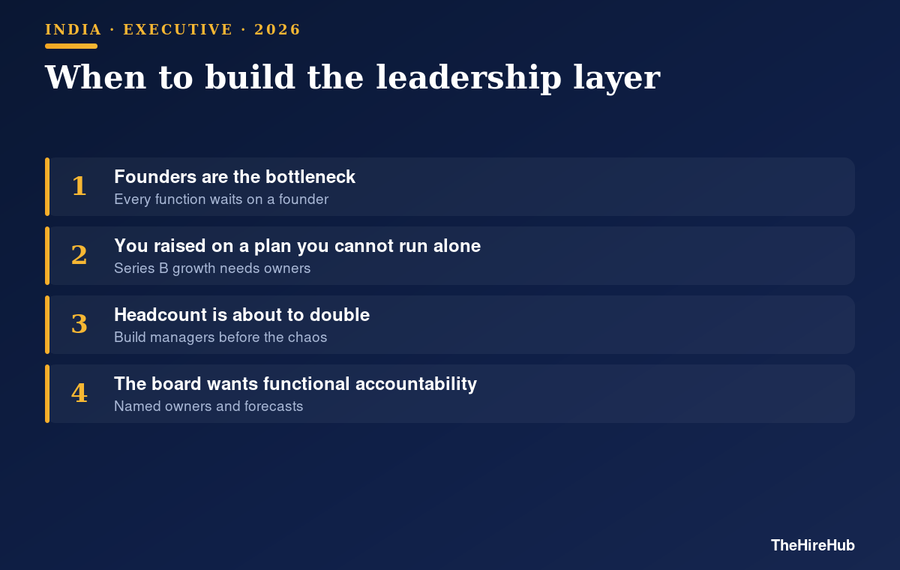
- The founders are the bottleneck in every function. When decisions stall because they wait on a founder, and the founders have no time to think strategically, it is time to hand functions to owners.
- You have raised on a plan you cannot personally execute. Series B capital comes with growth expectations that no two founders can deliver alone. The leadership layer is how you make the plan real.
- Headcount is about to double. If you are scaling from 150 to 400 people, you need managers of managers and an operating cadence before the growth, not after the chaos.
- The board wants functional accountability. Once investors expect named owners for revenue, product, finance, and people, with forecasts to match, the leadership build is no longer optional.
Series B leadership vs adjacent stages
The leadership needs at each stage are genuinely different, and copying the wrong stage is a common error. Series A leadership is usually about hiring strong functional heads and senior individual contributors who can both do the work and start a team; titles are often Head-of rather than C-level, and versatility beats specialisation. Series B leadership is the shift to true functional owners who build managers beneath them and own forecastable numbers, which is the transition this guide is about.
Series C and growth-stage leadership raises the bar again toward executives who have run at much larger scale, often with public-company or pre-IPO experience, and who manage through several layers (our pre-IPO and CXO guides cover that step up). The cleanest test for a Series B hire is whether the person can both build the system now and grow into the next stage: hire slightly ahead of your current scale, but not so far ahead that the leader is bored building from the ground up.
How to hire (and the four traps)
- The all-at-once trap. Founders flush with a fresh round hire five leaders in a quarter, overwhelm onboarding, and blow up culture. Sequence hires against your single biggest constraint (usually revenue or product) and let each leader bed in.
- The over-leveled-logo trap. A leader from a famous late-stage company may have inherited scale and struggle to build from your base. Probe for what they built at your stage, not what they managed at someone else's peak.
- The clone-the-founder trap. Hiring leaders who think exactly like the founders feels comfortable but adds no new capability. The point of the layer is to bring skills and judgment the founders lack, so hire for difference, not for comfort.
- The mis-sequenced-search trap. Running five generalist searches in parallel with no calibration wastes the round and surfaces the wrong profiles. A staged, calibrated approach to each seat is faster and cheaper. Our breakdown of executive search fees in India and executive search versus RPO lays out how to resource it.
See how TheHireHub speeds this up
Building a Series B leadership team is the most consequential hiring sequence a founder runs, and doing it ad hoc burns the round. TheHireHub helps founders map the leadership layer, sequence the seats against their actual constraint, and run AI-assisted, calibrated searches for each role with shortlists that fit your stage, in weeks rather than quarters. Book a demo to plan your leadership build, or see pricing and start a free trial.
The one thing every Indian CEO should take from this
Build your Series B leadership team as a sequence, not a shopping spree. The highest-leverage decision is to name your single biggest constraint, hire the leader who removes it first, let them prove the model and build their layer, then move to the next seat. Sequencing protects culture, runway, and your own attention, all of which are scarce in this window. Get it right and you graduate from founder-led to founder-guided. Get it wrong and you spend the round hiring leaders who do not stick. If you want help mapping and sequencing the build, book a hiring strategy call.
Ready to build your Series B leadership team?
The round is finite and the sequence matters. Book a demo with TheHireHub and we will help you map the layer, prioritise the seats, and build calibrated shortlists for each. Want to explore first? See pricing.
Secure Your Competitive Edge with TheHireHub.ai
By harnessing AI through TheHireHub.ai, HR leaders can eliminate the pain of losing top talent, slash time-to-fill and vacancy costs, and drive organizational success. Visit thehirehub.ai today to schedule a demo and experience 70% faster hiring tailored to your needs. Transform recruitment from a cost center into a strategic advantage—start now.
Stop scrolling resumes. Start hiring.
TheHireHub's AI hands you pre-screened, ready-to-interview candidates in hours, no agency fees, no signup gauntlet.
Curious how this works inside a real product? Explore TheHireHub’s agentic AI recruiting and see how it compares.
Frequently Asked Questions
Most Series B companies build a leadership layer of three to five senior owners across revenue, product, engineering, finance, and people, sequenced over the year rather than hired all at once.
Individual leaders typically cost ₹1 crore to ₹2.5 crore in total compensation, and the full layer often runs ₹6 crore to ₹12 crore a year in cash and equity before their teams.
Usually when the founders have become the bottleneck in every function, when the company crosses roughly ₹40 crore to ₹150 crore in revenue or 150 to 400 employees, or when the board wants functional accountability.
Hire against your single biggest constraint. For most it is a revenue leader or a finance leader, but the right first seat is whichever function is most limiting growth right now.
Forecast accuracy across functions, revenue growth against plan, burn multiple and capital efficiency, second-layer hiring and bench strength, time-to-productivity for new hires, and leadership retention.
Series A leadership is about versatile functional heads who do the work and start teams, while Series B leadership is about true functional owners who build managers beneath them and own forecastable numbers.
Both, but equity should be a meaningful slice. A leader who only optimises for cash is often the wrong bet for a company still proving it can scale.
Hiring all the senior leaders at once to look complete, which overwhelms onboarding and culture. Sequencing hires against the biggest constraint is faster and safer.
Each calibrated executive search typically runs eight to fourteen weeks, and a sensible sequenced build of the full layer usually spans six to twelve months.
For senior, stage-specific seats, a calibrated search shortens time-to-hire and improves the odds the leader sticks, and the fee usually pays for itself against the cost of a mis-hire during hypergrowth.


