
How to Hire a CMO in India (2026 Guide)
The role, the salary bands, the six KPIs, and the four traps that cost Indian founders their first marketing hire.
Hiring a CMO in India 2026: the five things the role actually owns, salary bands by stage, six KPIs every founder should track, and the four traps that sink most searches.

A Chief Marketing Officer in India 2026 is the person who turns positioning, demand, and brand into a repeatable growth engine that the CFO can model. Expect to pay between ₹1.2 crore and ₹4.5 crore in total compensation depending on stage, with most Series B to Series D startups landing in the ₹1.8 crore to ₹2.8 crore band. The trigger to hire is not "we need more leads"; it is the moment a founder can no longer sit in every positioning call, every brand decision, and every revenue planning meeting at once. Most Indian founders hire a CMO 12 to 18 months too late, then expect the role to fix a broken pipeline in one quarter. If you are unsure whether your real gap is a CMO or a VP of Sales, read on. The right answer is almost never both at the same time.
What this role actually owns
A modern Indian CMO is not a "head of brand" with a bigger title. The role spans five concrete functions, and a candidate who is genuinely strong in only two of them is a VP, not a CMO.
- Positioning and category design. The CMO owns the answer to "what are we, who is it for, and why now". This is the work that defines the slide every salesperson uses, the wording on the homepage, and the analyst narrative. If positioning is wrong, every rupee spent downstream is half wasted. In India 2026, where GTM motions have splintered across PLG, sales-led, ABM, and partner-led, positioning has become the highest leverage CMO output.
- Demand generation and pipeline. Owning a number the CFO can audit. That means MQL to SQL to closed-won ratios, payback period on paid channels, organic and AI search visibility, and CAC by segment. The CMO is accountable for sourced pipeline, not just impressions. In B2B SaaS this usually sits at 35 to 60 percent of total pipeline; in D2C and consumer it is closer to 80 percent.
- Brand, PR, and category authority. Founder positioning, analyst relations, press, podcasts, and the long compounding work that does not show up in this quarter's dashboard. In India 2026 this also includes AI overview visibility (how your brand shows up inside ChatGPT, Perplexity, and Google AI search), which is now a board level metric for most growth stage companies.
- Product marketing and pricing. Launches, packaging, pricing pages, sales enablement, win-loss analysis, and competitive intelligence. This is the function most often missing in Indian startups under ₹100 crore ARR, and it is also the single biggest reason sales teams complain that "marketing leads are bad".
- Customer marketing and lifecycle. Retention, expansion, advocacy, case studies, NPS programmes, and community. For SaaS and subscription businesses this drives 40 to 70 percent of new ARR through expansion and referrals; for D2C it is the entire repeat purchase engine.
Salary in India 2026 (with bands)
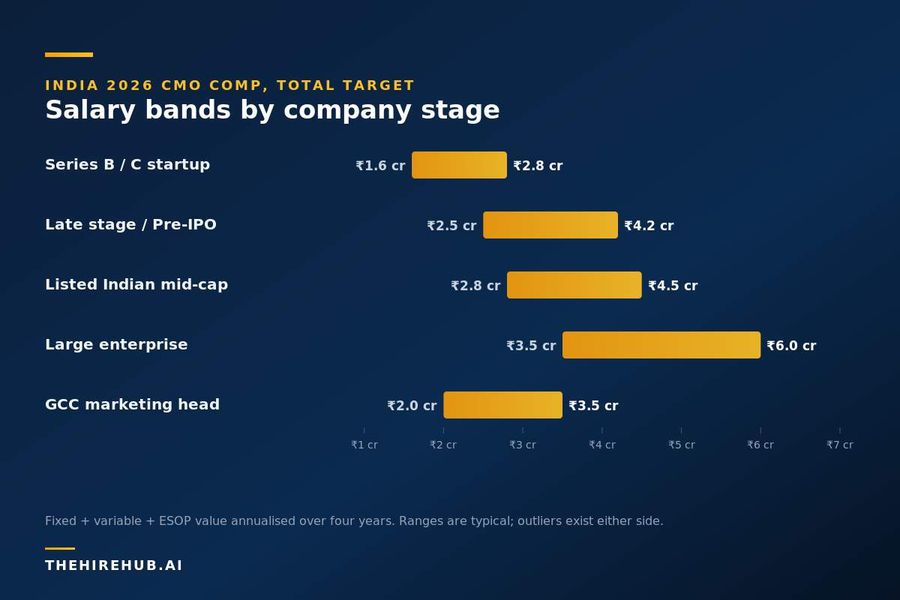
Indian CMO compensation has compressed at the top and expanded at the bottom over the last 18 months. Series A and early B founders are paying more than ever for proven operators, while listed mid-caps have started indexing on equity rather than cash. All figures below are total target compensation (fixed plus variable plus ESOP value annualised over four years).
For a Series B or C startup (roughly ₹50 crore to ₹200 crore ARR or equivalent revenue), expect ₹1.6 crore to ₹2.8 crore total target comp. Fixed is usually ₹1.0 crore to ₹1.6 crore, variable 20 to 30 percent, and ESOPs worth ₹40 lakh to ₹80 lakh a year at fair value. A late stage or pre-IPO company (₹200 crore to ₹800 crore ARR) sits at ₹2.5 crore to ₹4.2 crore, with the variable component creeping toward 35 percent and ESOPs that often dominate the package if the IPO is within 24 months. A listed Indian mid-cap pays ₹2.8 crore to ₹4.5 crore, weighted toward fixed plus performance stock units rather than ESOPs. Large enterprises (BFSI, telco, large consumer) sit at ₹3.5 crore to ₹6 crore for a true CMO, with the highest packages reserved for category leaders running ₹500 crore plus marketing budgets. A GCC marketing head running a global brand out of Bengaluru or Gurugram typically lands at ₹2.0 crore to ₹3.5 crore, but the role is usually scoped narrower (regional marketing or a specific business unit) than a true India market CMO.
Calibration points before you sign anything:
- A founder paying top of band should expect the CMO to land a measurable pipeline lift inside two quarters and a positioning reset inside one. If the JD does not say that, you are overpaying.
- Variable comp should be tied to sourced pipeline or revenue, not "campaigns delivered". The latter is a vanity goal and almost guarantees friction with the VP of Sales.
- ESOP value should be discussed at fair value, not face value. A ₹2 crore grant at face value can be worth ₹40 lakh or ₹4 crore depending on strike, vest, and exit assumptions.
The six KPIs this role is measured on
If your CMO does not have a number against each of these six lines in their first 30 day plan, you have hired a director, not a CMO.
- Sourced pipeline contribution. What percentage of new pipeline is sourced or influenced by marketing, tracked monthly, with a target that grows quarter over quarter. For B2B SaaS in India 2026, 35 to 60 percent sourced is the operating band; below 25 percent and marketing is a cost centre, above 70 percent and sales is under-invested.
- CAC and payback period. Blended CAC and payback by segment and channel, with a clear ceiling tied to LTV. In Indian SaaS, payback under 18 months is healthy; in D2C, under 6 months on first order. If the CMO cannot produce this number in week two, they are not a CMO.
- Win rate and ACV movement. Marketing's job is not just leads; it is the right leads at the right price point. Win rate and ACV are joint KPIs with sales, and the absence of joint accountability here is the single most common reason CMO tenures end at 14 months. For deeper context see our hiring intelligence audit guide.
- Brand and category authority signals. Unaided brand recall in target ICP, share of voice in analyst reports, AI overview presence (how often your brand appears in ChatGPT or Perplexity answers for relevant queries), inbound founder mentions, and press of record. These are quarterly, not monthly.
- Retention and expansion contribution. Net revenue retention movement attributable to marketing programmes (lifecycle, advocacy, community). For SaaS, 5 to 15 percent of NRR lift is a reasonable target for a strong CMO inside year one.
- Team build and bench strength. Direct reports hired, retained, and promoted; reduction in agency dependency; and a documented succession plan for at least two roles. If a CMO is irreplaceable after 18 months, they have failed at this KPI.
When you actually need this role
Most Indian founders hire a CMO either too early (Series A, when the answer is a senior product marketer and a growth lead) or 12 months too late (Series C, when the marketing function is a mess of agencies and ad-hoc hires). The four trigger conditions below are reliable.
- The founder is in every positioning call, every brand decision, and every pricing conversation, and is the bottleneck on at least two of the three. This usually happens between ₹40 crore and ₹120 crore ARR.
- The company has at least two distinct ICPs, two pricing tiers, or two go-to-market motions (PLG plus sales-led, or India plus US), and the current marketing team cannot serve both without dropping balls.
- Sales pipeline is growing slower than headcount, or CAC is rising faster than ACV for two consecutive quarters. This is the demand generation signal.
- The next 18 months include a category narrative shift (IPO prep, new product line, new geography, M&A), and the founder cannot personally own the narrative work alongside everything else.
CMO vs adjacent titles
The Indian market routinely confuses CMO with VP Marketing, Head of Growth, and CGO. They are not the same role and the JD should not pretend they are. A VP Marketing typically owns demand and brand but reports into a CMO or CRO and does not sit in board conversations on positioning or pricing. A Head of Growth is usually a performance and product-led growth operator, weighted toward analytics and experimentation, and often does not own brand or PR. A Chief Growth Officer (CGO) is a hybrid revenue role that can include sales as well as marketing; if you are unsure whether you need a CMO or a CGO, the test is whether the role should own a sales quota. If yes, you want a CGO or a VP of Sales plus a CMO, not a CMO alone.
A related confusion is between a CMO and a senior product marketer. Companies under ₹100 crore ARR often genuinely need a strong head of product marketing first, then a CMO 12 to 18 months later. Hiring a CMO before you have product market fit signal is the most expensive mistake in this category, and it is closely related to the VP Engineering vs CTO question: senior generalists are not always the right first hire when a specialist is what the business actually needs.
How to hire (and the four traps)
The Indian CMO market in 2026 is small, expensive, and noisy. Four traps account for most failed searches.
- Hiring the resume, not the operating model. A candidate from a ₹1,000 crore brand is not automatically the right hire for a ₹100 crore startup. The operating models are different: enterprise CMOs run committees, startup CMOs run sprints. Reference checks should focus on the last two years of operating cadence, not the brand on the badge. See our executive search fees explainer for what good calibration looks like in a retained search.
- Confusing brand polish with operating depth. The most charismatic CMO candidate is rarely the most operationally rigorous one. Ask for a specific example of a CAC payback they brought down, a positioning they rewrote, or a launch they killed because the data said no. Vague answers here are disqualifying.
- No joint scorecard with sales. If the CMO and VP Sales do not share at least three KPIs (sourced pipeline, win rate, payback), the role will fail inside 18 months regardless of who you hire. Build the scorecard before you start interviewing.
- Compensation that ignores ESOP literacy. Indian executives in 2026 are far more ESOP literate than they were in 2022. A CMO who does not negotiate hard on strike, vest, and acceleration is not the operator you want; it signals they have not done this before. Conversely, founders who lowball cash and inflate ESOP face value are filtering out exactly the candidates they want.
The one thing every Indian CEO should take from this
A CMO is not a fix for a broken pipeline, and it is not a brand upgrade in human form. It is a structural decision about who owns the answer to "what are we, who is it for, and why now" at the same level of seriousness as the founder and the CFO. Get that decision right and the next two years of growth look very different. Get it wrong and you will spend ₹3 crore learning that the gap was not marketing at all. If you are working through this decision and want a second pair of eyes on the JD, the scorecard, or the comp band, book a hiring strategy call.
Secure Your Competitive Edge with TheHireHub.ai
By harnessing AI through TheHireHub.ai, HR leaders can eliminate the pain of losing top talent, slash time-to-fill and vacancy costs, and drive organizational success. Visit thehirehub.ai today to schedule a demo and experience 70% faster hiring tailored to your needs. Transform recruitment from a cost center into a strategic advantage—start now.
Stop scrolling resumes. Start hiring.
TheHireHub's AI hands you pre-screened, ready-to-interview candidates in hours, no agency fees, no signup gauntlet.
Curious how this works inside a real product? Explore TheHireHub’s agentic AI recruiting and see how it compares.
Frequently Asked Questions
Usually between ₹40 crore and ₹120 crore ARR for B2B SaaS, and earlier (₹20 crore to ₹60 crore revenue) for D2C and consumer brands. The trigger is structural complexity, not absolute revenue: multiple ICPs, multiple GTM motions, or a founder who has become the bottleneck on positioning and brand decisions.
Most Series B to D startups pay ₹1.6 crore to ₹2.8 crore total target comp. Listed mid-caps and large enterprises pay ₹2.8 crore to ₹4.5 crore, and pre-IPO companies can go higher when ESOPs are factored at fair value. GCC marketing heads typically land at ₹2.0 crore to ₹3.5 crore for narrower scopes.
Yes, but not personally. The CMO sets the CAC ceiling, owns the channel mix decision, and signs off on the budget; a Head of Growth or performance lead runs the day to day execution. A CMO who is personally tuning ad accounts is usually being mis-deployed.
A Head of Growth is usually a specialist in performance, analytics, and product-led experimentation, and reports into a CMO or COO. A CMO owns the full marketing function including brand, PR, product marketing, and lifecycle, and sits in board level conversations on positioning and pricing.
Almost never. Pre-PMF companies are better served by a senior product marketer (₹40 lakh to ₹80 lakh) and a founder who stays close to positioning. Hiring a CMO before PMF is the most expensive miscalibration in this category.
A retained executive search for a CMO typically runs 10 to 16 weeks from kickoff to signed offer, with another 60 to 90 days of notice period for the candidate. Plan a six month gap between deciding to hire and the new CMO actually starting.
Around 2.5 to 3 years across high growth companies, and 3.5 to 4.5 years at listed mid-caps. Tenures under 18 months almost always trace back to misaligned scorecards or a missing joint number with sales.
In almost every case, to the CEO. A CMO reporting to a CRO loses brand, PR, and positioning authority over time and ends up running demand generation only, which is not the role you signed up to hire.
Typical grants are 0.4 to 1.2 percent for a Series B to C startup, vesting over four years with a one year cliff. Pre-IPO grants are smaller in percentage but often larger in expected value.
Vague answers on numbers. If a candidate cannot tell you the CAC payback, win rate, or sourced pipeline percentage at their last company within two minutes, they did not own those numbers and they will not own yours.


